
Eight people sealed inside a miniature Earth… whose oxygen was disappearing
In Arizona, eight people lived under glass with a forest, an ocean, crops, and animals. Sixteen months later, they opened a door and found that the air beyond it gave them back an energy they had forgotten.
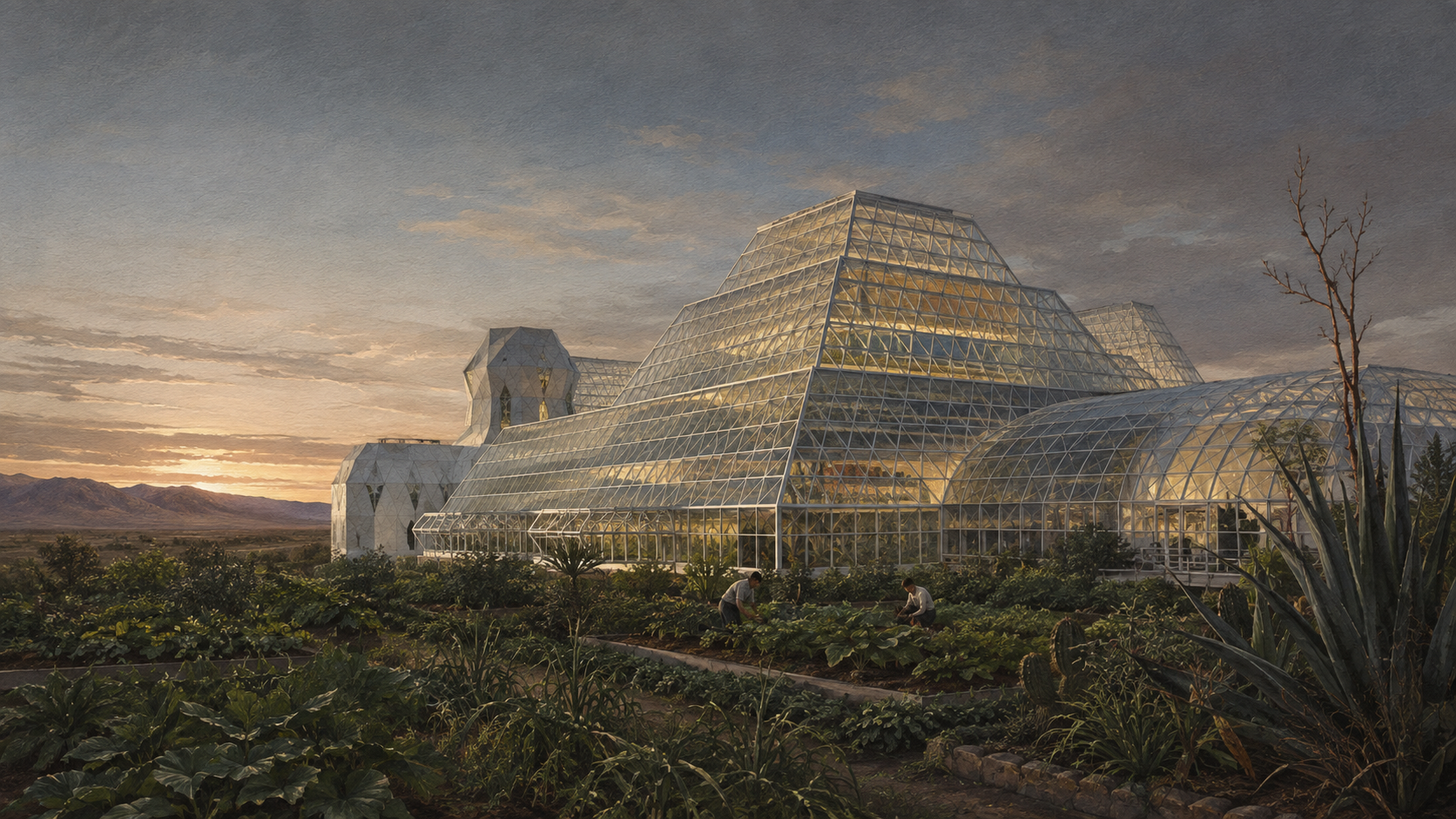
In January 1993, eight people walked through a door and breathed air they had not known for months.
On the other side, oxygen was about 26 percent. On their side, inside Biosphere 2, it had fallen to roughly 14 percent.
Mark Nelson, one of the eight residents, later wrote that the team felt a startling physical change within minutes. They had been living as though they were almost 15,000 feet above sea level, despite being in the Arizona desert.
The strangest part was not that someone brought them oxygen.
It was that they were surrounded by plants.
A miniature Earth under glass
On September 26, 1991, eight volunteers moved into a structure near Oracle, Arizona, designed to reproduce part of Earth’s biosphere. A rainforest stood beside a savannah, a desert, marshes, and a small ocean with a coral reef. There were also fields, animals, and living quarters.
The name captured the ambition: biosphere number one was Earth. The second was meant to show what happens when living environments and humans share one enclosure, along with their water, food, and air.
The building was not perfectly airtight, but exchange with the outside was low enough for internal transformations to become visible. That was exactly what its designers wanted to observe. An ordinary greenhouse can be ventilated and constantly corrected; Biosphere 2 was meant to show what happens when the air becomes the outcome of everything living inside it.
The participants were not trapped. Airlocks could be opened if their health required it. But the project only made sense if they stayed long enough to see whether this miniature Earth could cycle its own resources.
At first, the most immediate problem was food.
Growing every meal
The residents grew rice, sweet potatoes, bananas, and papayas, among other crops. They cared for animals, harvested, cooked, trapped insects, and tried to save plants attacked by pests and disease.
Farming and food-related work took up nearly half their time. The crops supplied most, but not all, of what they ate; stores placed inside at the start supplemented the diet. The residents lost weight in the first months and spoke of persistent hunger.
That hunger was a reminder that the experiment was not futuristic scenery. Every kilogram of food had to be produced, harvested, and shared. The crops had to grow behind glazing and a supporting structure that admitted only part of the light available outdoors. The plants were both the crew’s pantry and part of its breathing system.
The system was alive, which meant it was always working. Plants made oxygen when they received light. Animals, microbes, and soils consumed it. Carbon dioxide rose at night and plants drew some of it down during the day.
Inside Biosphere 2, those changes were unusually visible. The light coming through the glass and supporting structure could change the curves: researchers could see the passage of a cloud over the building in the CO₂ measurements.
The instruments were watching the air. One of their numbers began to fall.
A forest, crops—and less air to breathe
At the start, oxygen made up 20.94 percent of the enclosed atmosphere, as it does on Earth. Less than a year after closure, it was near 16 percent. The decline continued.
This was not a theoretical inconvenience. At that level, the partial pressure of oxygen resembles conditions at high altitude. The residents kept working, gardening, and living among trees, but their bodies were receiving less and less of what outdoor air supplies unnoticed.
Researchers looked at CO₂. It was being produced by respiration and decomposition, then partly taken up by plants. Yet the calculations did not fully explain the oxygen deficit. Part of the story was missing.
The mystery was not only in the air.
They had to look at the soil and the walls
The soils had been installed with abundant organic matter to get the ecosystems started. Microbes breaking down that matter consumed oxygen. Plants replaced some through photosynthesis, but the balance was more fragile than expected, especially when light was scarce.
Nor did all the carbon dioxide produced remain in the atmosphere. Some was fixed as carbonates by materials and by CO₂-control systems; soils themselves also took part in reactions that consumed or immobilized oxygen.
This is not the easy story of a single villain hiding in concrete. It is a more unsettling one: in a closed world, every material and every microbe joins the accounting. Something tiny on the scale of Earth becomes measurable on the scale of one building.
As oxygen approached 14 percent, the outside team decided to introduce more from beyond the enclosure. They did not claim the system had saved itself. They chose to protect the eight people living inside it.
The doorway scene captures the gap between a number and a body. At 14 percent, air is not absent: people can still talk, walk, and work. But it turns every effort into high-altitude effort. The oxygen added to the adjoining chamber did not repair the system; it suddenly revealed everything the residents had learned to endure.
Air from the first biosphere
The added oxygen allowed the mission to continue until September 1993, completing the planned two years.
Biosphere 2 did not demonstrate that a self-sufficient ecosystem could perfectly feed and oxygenate its residents without outside help. Electricity already came from outside, stored food had supplemented the crops, and oxygen had to be added.
But the experiment was far from empty. It made visible what usually remains hidden on Earth: the connections between soils, microbes, light, plants, construction materials, and human breathing. On our planet, the scale is so vast that air feels automatic. Under glass, it becomes a balance that must work every day.
That is why Biosphere 2 remains interesting despite its limits. It did not deliver a ready-made little planet. It showed how hard a planet is to miniaturize without discovering, too late, an actor everyone had forgotten.
Biosphere 2 had been built to imitate a small Earth.
What saved it was air from the first one.
Sources and checks
- Mark Nelson, University of Arizona Press — account of the 14-percent-oxygen episode.
- Nelson et al., 1994 — oxygen, CO₂, soil and material measurements.
- Alling et al., 2005 — system structure and dynamics.
- Silverstone and Nelson — food production and diet.
Leave a Reply