
His cargo ship sank in two minutes. For him, the story was only beginning.
In November 1942, Poon Lim reached a raft after his ship was torpedoed. It carried water, food—and one terrible fact: none of it meant he had been saved.
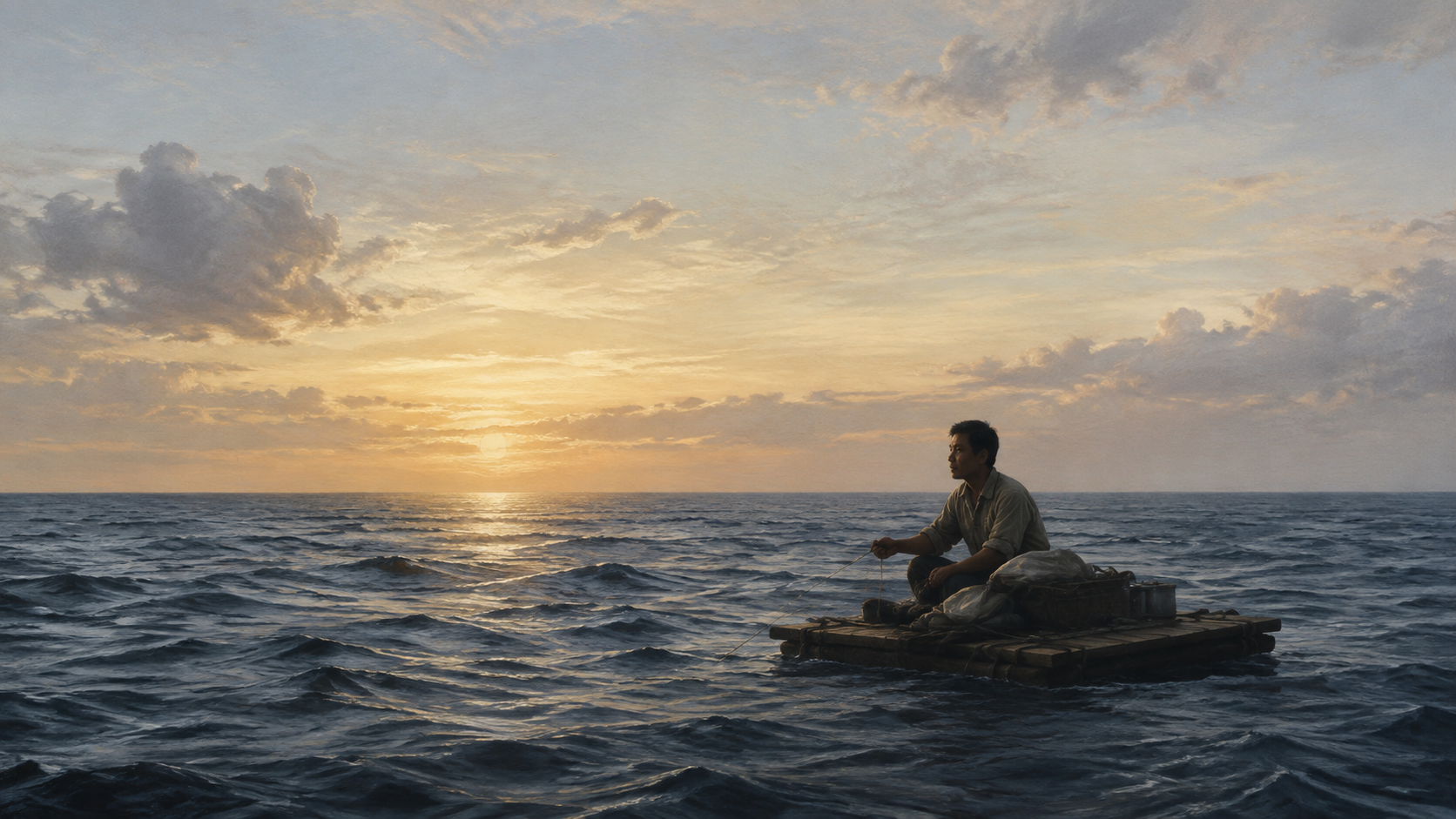
The Benlomond was gone in about two minutes.
Poon Lim, a Chinese second steward aboard the British cargo ship, spent nearly two hours in the Atlantic before reaching a raft. A submarine had torpedoed the vessel on November 23, 1942. There was no deck left beneath him, no cabin to return to, no crew in sight. Just a small platform drifting on open water.
The raft held food and drinking water. Enough supplies for about fifty days.
After a sinking, that can sound almost like a victory.
It was not. Fifty days were not rescue. They were a deadline.
A raft is not a way home
At first, hunger was not the worst problem. Direction was.
Poon Lim had food, but no engine, no reliable way to call for help, no idea who was looking for the Benlomond or where the currents were carrying him. As the raft drifted farther away, the supplies stopped feeling reassuring. They became a private calendar.
He would have to learn not merely to use them, but to outlast them.
In his 1978 interview, Lim remembered a very specific inventory: hardtack, chocolate, canned concentrated meat, evaporated milk, lime juice, and ten gallons of water. There were also a tarpaulin, paddles, flares and smoke pots, a flashlight, rope, and a few containers.
It was not the equipment of someone prepared to cross the Atlantic. It was the equipment of someone expected to last until another ship arrived. That difference mattered.
In an account he gave decades later, Lim described an early moment that might have ended everything. After his first week, he saw a ship and set off smoke signals to attract attention.
The ship kept going.
No one knows why. Perhaps the crew did not see him; perhaps the signal was too far away or too brief. Lim never found out. What mattered was simpler: the first sign of other people since the sinking had vanished beyond the horizon.
Decades later, he described another missed chance. Around his hundredth day at sea, he saw a formation of aircraft and signalled them. One plane came down to inspect the raft, then left. Lim thought the sea might have been too rough for a rescue, but it remained only his guess.
From that moment, he could no longer live as someone waiting to be rescued. He had to live as someone who might never be.
Turning a flashlight into food
The raft’s biscuits could feed one man. They could not feed him for four months.
Lim took the spring from a flashlight and shaped it into a hook. He improvised a line, baited it with biscuit, and waited. The first fish were small. He used them as bait for larger fish.
Read afterward, the trick sounds almost calm. On the raft, it answered the question that returned every day: how do you make tomorrow last without eating it today?
He also made a knife from the metal of a tin can. Larger catches were cut into strips and dried in the sun. When he no longer had biscuit for bait, he said he used barnacles clinging to the raft. The dried fish attracted birds; he caught some of those too.
These were not separate feats of ingenuity. They were a fragile system. The spring had to hold. The line had to catch something. The sun had to dry the fish before it spoiled. And Lim had to stay well enough to do it again.
The sea could provide food. It could not provide the thing that was becoming more dangerous than hunger: fresh water.
Five days waiting for rain
Eventually, the water supply ran out.
The official citation that later accompanied Lim’s British Empire Medal says he went five days without water. On a raft exposed to salt and sun, five days are short enough to count hour by hour—and long enough to end a survival story.
He used the covering material from his life jacket to catch rainwater. In his 1978 interview, he also described arranging a tarpaulin so that water would run down into a container.
Then the rain came. He could drink again.
The 1978 interview also reveals another kind of survival, less visible than a hook: time itself had to be occupied. Lim said he thought about his family, replayed his childhood on Hainan Island, and imagined the future. Each day became a simple instruction: keep his mind active until someone could see him.
But that is the trap at the heart of the story: every success bought time, not escape. Catching a fish did not create water. Catching rain did not guarantee the next shower. A ship could still pass and never turn around.
November became December. Then the year changed.
The sinking belonged to 1942. Poon Lim was still at sea in 1943.
The day someone finally stopped
On April 5, 1943, a Brazilian fishing boat spotted the raft and took him aboard. Poon Lim had spent 133 days alone at sea. In his own account, he said a Brazilian fishing family kept him aboard for three days before returning to shore; they did not share a language, but the condition of the raft already said enough about what had happened.
Three days later, he landed in Belém. Rescue did not immediately end one final uncertainty: did anyone on shore still know that he had belonged to the Benlomond?
In his own account, he said he asked for the British consul. He gave his name and the ship’s name. The records were checked.
The answer was terrible because it was so administrative: no other man from the Benlomond had returned.
For more than four months, Poon Lim had needed one boat to see him. When a boat finally did, he learned there would be no one else left to tell the story of the sinking beside him.
Sources and checks
- The London Gazette, July 13, 1943 — official medal citation confirming duration, provisions, water, and survival methods.
- Uboat.net — Benlomond — sinking context and crew outcome.
- Poon Lim interview, 1978 — spring, tools, fishing, and recollections of rescue.
Leave a Reply