
Part of the fuselage tore away at 24,000 feet. The Boeing still landed.
Aloha Flight 243 is flying between two Hawaiian islands when a sudden noise fills the cockpit. Behind the pilots, wind rushes through the cabin.
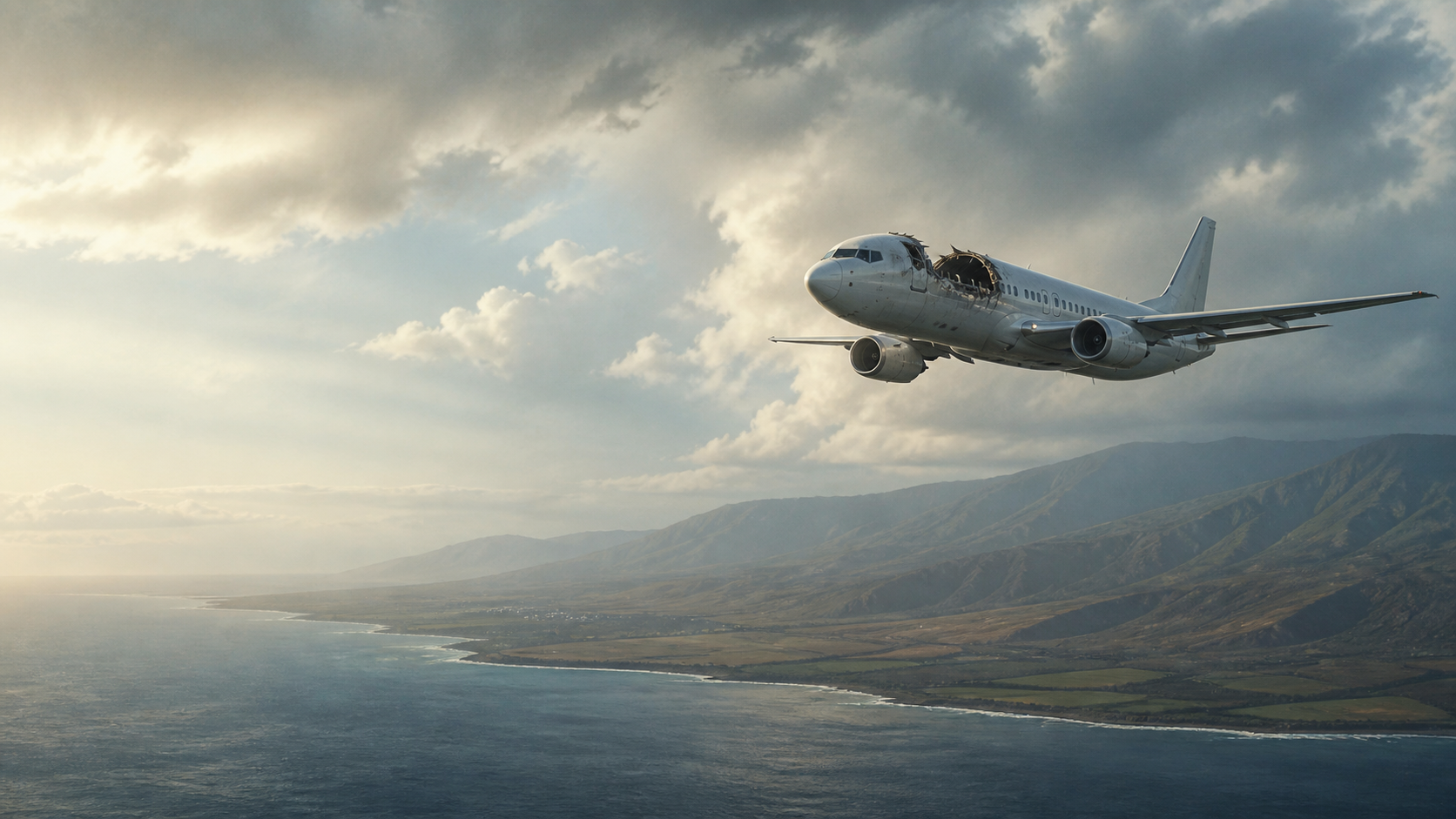
Robert Schornstheimer turns around. The cockpit door is gone. Where the first-class ceiling should be, the captain can see the sky.
Moments earlier, the Boeing 737 levelled off at 24,000 feet, approximately 7,300 metres. It is flying from Hilo to Honolulu on 28 April 1988, carrying 89 passengers and six crew members. First officer Madeline Tompkins has felt her head thrown backwards. Pieces of grey insulation float in front of the pilots.
These impressions, which they will describe to investigators, are their first glimpse of the damage. Part of the upper skin and structure has separated behind the forward entrance door. The opening extends roughly 18 feet, or 5.5 metres. Several rows of passengers are exposed to the open air.
Clarabelle Lansing, a 58-year-old flight attendant, was in the aisle near the fifth row. She is swept out of the aircraft. She will be presumed fatally injured in the accident.
In the cockpit, Schornstheimer takes control. The controls feel unusually loose. The Boeing is still flying, but he needs to get it down.
They start by communicating with their hands
Both pilots put on their oxygen masks. The captain deploys the speed brakes and begins an emergency descent towards Maui. The noise is so loud that at first they communicate through gestures.
The passengers had been seated and the fasten-seat-belt sign was on. One flight attendant has been thrown to the floor; she subsequently manages to help passengers. Another has suffered serious head injuries. Seven passengers are also seriously injured.
Tompkins cannot reach the flight attendants. From the cockpit, the pilots must keep going without receiving a cabin report from them. As they descend and slow down, the first officer can finally talk to the tower at Kahului. She asks for help to be ready for the passengers.
The captain tries to configure the aircraft for landing. But extending the flaps further makes the Boeing harder to control. It also handles worse when he slows it further. Schornstheimer keeps the flaps partly extended and avoids reducing his speed any more.
Another problem appears: the indicators confirm the main landing gear is down, but not the nose gear. The manual procedure does not provide the expected confirmation either.
Then the captain notices a movement of the aircraft and concludes that the left engine is no longer responding. An attempt to restart it fails. The runway is approaching, with an open cabin, an engine that will not restart and a nose gear whose locked position the pilots cannot confirm.
Around four miles from the runway, Schornstheimer establishes a normal descent path. The Boeing touches down at Kahului less than thirteen minutes after the rupture. Braking and the right engine's thrust reverser bring it to a stop on the runway. Evacuation begins.
Ninety-four of the ninety-five people who left Hilo have returned to the ground.
What a passenger saw while boarding
After the accident, a passenger will tell investigators that she noticed a crack near a row of rivets while boarding. She had not reported it.
Investigators examine the maintenance programme that was supposed to detect structural deterioration.
The Boeing was built in 1969. By the accident, it had accumulated almost 35,500 flight hours but nearly 90,000 cycles, each including a take-off and landing. It then had the second-highest cycle total of any 737 in the world.
Journeys between the islands are short. The aircraft takes off again and again without adding many hours to its total. Yet pressurisation loads the fuselage on every rotation: the metal skin is stressed, then the stress eases. Not every flight imposes precisely the same load, but repetition matters in the development of cracks.
According to the FAA's analysis, Aloha's aircraft accumulated cycles about twice as quickly as Boeing's maintenance recommendations had anticipated. Flight hours alone could not show how often their joints had been loaded.
Around the rivets
On this early model, the aluminium fuselage panels overlap. Adhesive and rows of rivets hold them together. The bond is meant to distribute loads between the two metal skins.
But that bond can deteriorate. Manufacturing difficulties and corrosion weaken the assembly. When the adhesive no longer transfers loads properly, the rivets take them. Stress concentrates in the metal around their holes.
Investigators reconstruct a failure that does not necessarily begin with one large crack. Small cracks develop at several neighbouring points. With repeated loading, they can join up. Reinforcement intended to limit an opening can no longer do its expected job when damage is distributed in this way and the bond has deteriorated.
According to the reconstruction by the NTSB, the US transport accident investigation agency, those cracks joined along a fuselage joint. The upper section separated. The missing section was not recovered, so the precise origin remains a reconstruction, rather than a fracture investigators could examine in its entirety.
Preventing the rupture meant finding the damage while the cracks were still separate.
An aircraft inspected in pieces
At Aloha, the major structural inspection was divided into 52 separate packages over eight years, often carried out at night. The NTSB found that this organisation prevented a sufficient assessment of the aircraft's overall condition. It also failed to account adequately for the rapid accumulation of cycles.
The problem was not entirely new. The airline had already found a crack along a comparable joint on another 737. Boeing had recommended inspecting several joints, but the FAA's 1987 mandatory requirement covered only some of them. The joint that failed on Flight 243 was not among them.
The NTSB majority identified the failure of Aloha's maintenance programme to detect disbonding and fatigue as the probable cause. It also identified failures of supervision and FAA oversight. In a statement appended to the report, member Joseph T. Nall considered that attribution too narrow: he would have placed the undetected damage first and listed the various parties' decisions as contributing factors. He did not dispute the structural failure mechanism.
Measures following the accident included corrosion controls and greater attention to distributed fatigue damage. The issue was no longer simply finding a crack long enough to cause concern: several small cracks could create the danger together.
The pilots pulled off the extraordinary feat of bringing it back to the ground. The investigation showed why it should never have left it.
Sources and checks
- NTSB — investigation DCA88MA054.
- NTSB — report AAR-89/03, FAA copy, flight history pp. 2–4, analysis and Nall statement p. 78.
- FAA — Aloha Airlines Flight 243.
- NTSB — recommendations A-89-70 through -72.
- NTSB — recommendation A-89-73.
Leave a Reply