
He Made Himself Ill to Overturn a Medical Certainty
A doctor swallowed a bacterium to answer a question that sounded absurd at the time: could it really live in the stomach?
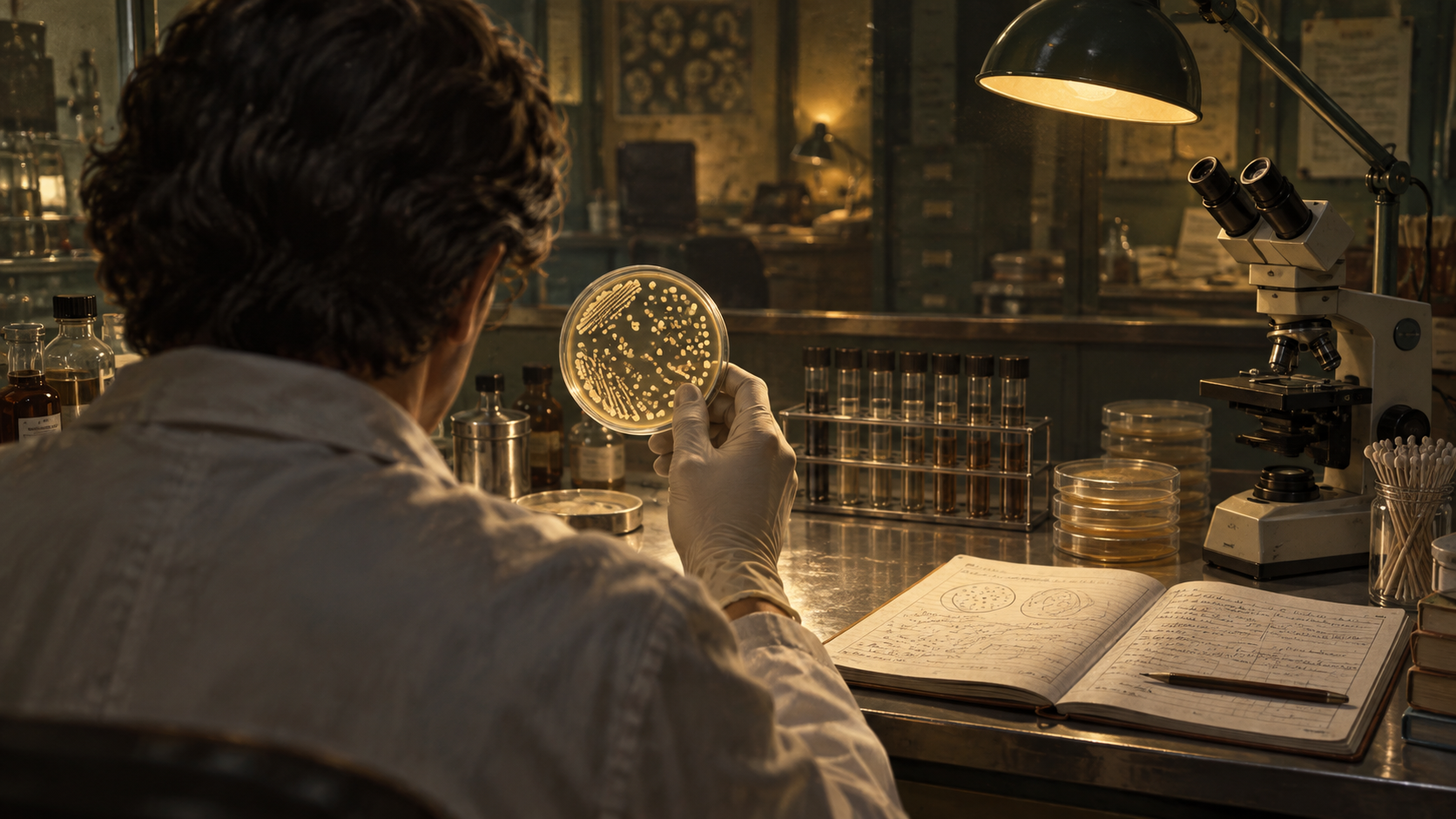
In 1984, Barry Marshall swallowed a bacterial culture. He was not trying to stage a stunt. He was trying to answer a question medicine still tended to dismiss: how could a germ possibly live in a human stomach?
When Barry Marshall took that preparation, he knew it was no harmless gesture. The bacterium came from a human stomach. At the time it was known by another name, pyloric Campylobacter. Today it is called Helicobacter pylori.
The argument behind it sounded almost absurd to many doctors: a microbe might play a part in gastritis and ulcer disease. The stomach is acidic. Very acidic. For a long time, that fact seemed enough to end the conversation. Such a place did not look like somewhere a bacterium could survive for long. Stomach pain already had familiar suspects: acid, stress, diet, lifestyle.
Marshall had an idea in front of him that would not go away. He decided to put it inside his own body.
The bacteria nobody expected to find there
The story does not begin with Marshall alone. In Perth, pathologist Robin Warren had been seeing strange spiral bacteria on stomach biopsies. This was not an abstract image on a slide. The organisms kept appearing where tissue was inflamed.
Marshall, a young doctor, became interested. Together, the two Australians gathered biopsies, cultures and comparisons. In 1982, they isolated the organism from gastric mucosa. Their work did not yet say, “this is the cause of every ulcer.” It asked a far more awkward question: if this bacterium kept turning up in diseased stomachs, why was it there?
Association is not proof. A bacterium can cause illness. It can also arrive after damage has already begun. Or both things may share another cause. In a field that had long treated ulcers by reducing acid, the idea of a germ looked, at first, like a laboratory curiosity.
The cultures made that doubt harder to ignore. In a 1985 Medical Journal of Australia paper, the team reported that the organism was often cultured from patients whose stomach lining showed the relevant abnormalities under the microscope, and not from those with normal-looking mucosa. That was not a final verdict. But it was no longer an easy coincidence.
The culture the laboratory could have thrown away
The first obstacle was not only intellectual. It was practical. Gastric bacteria did not behave like the fast-growing cultures the laboratory was used to handling. Early attempts were stopped too soon. Then a set of plates was left to incubate longer, over the Easter weekend of 1982. After roughly five days, colonies appeared.
There was no miracle concealed in a test tube. That did not prove by itself that the bacterium caused disease. But it changed what could be tested. Without a culture, Warren and Marshall had only microscope images, easy to dismiss as a curiosity. With one, they could compare biopsies, identify the organism and ask other teams to look for the same thing.
The discovery therefore moved forward through an almost awkward lesson: perhaps the microbe had not been absent from the stomach at all. Perhaps it had simply not been given enough time to show itself.
When there was no volunteer left
To go further, someone had to show that a healthy person could be colonised and become ill. There was nothing neat about that problem. It led to a question nobody really wanted to answer: who would volunteer to become the evidence?
Marshall eventually answered it himself.
In 1984, he drank a culture of the organism. In later accounts, he described discomfort followed by acute digestive illness: nausea, vomiting, bad breath and loss of appetite. Within days, the experiment had stopped being theoretical. Examination of his stomach showed acute gastritis, and the bacterium was found there.
The act is dramatic, but its result deserves better than a legend. Marshall did not simply “give himself an ulcer in a week” to win an argument. His experiment showed that an organism from a diseased stomach could colonise the stomach of a healthy man and cause acute inflammation. It was a powerful piece of evidence, not a magical shortcut that settled every cause of ulcer disease.
That distinction makes the story more compelling. The doctor did not force reality to say exactly what he wanted. He gained a specific proof, then still had to persuade people through further research, more patients and more results.
An old explanation did not fall overnight
Medical ideas do not change because one experiment is clever. They change when results become too useful to work around. Marshall and Warren kept going. The bacterium later received its final name, Helicobacter pylori. Studies established its role in gastritis and in much ulcer disease, while clinicians learned to look for the infection and treat it when it was present.
That did not mean stress explained everything before, and bacteria explained everything after. Drugs such as anti-inflammatory medicines can cause ulcers too. But the map of the problem had changed. For many patients, lowering acid was no longer enough; doctors had to ask whether they were treating the right cause.
The difference was concrete. Treatment that reduces acid can bring relief, but it does not necessarily address a persistent infection. Once H. pylori could be sought and treated in the relevant cases, the clinical question was no longer only, “how do we calm the stomach?” It became, “what is keeping the injury alive?” That is less dramatic than a doctor swallowing a culture. It is also where the hypothesis became a lasting change in practice.
In 1994, a US consensus conference recognised the central importance of detecting and eradicating H. pylori in the relevant ulcer cases. In 2005, Marshall and Warren shared the Nobel Prize in Physiology or Medicine for discovering the bacterium and its role in gastritis and peptic ulcer disease.
What he had really swallowed
The Nobel Prize is the obvious final image of this story. But the more important one may be smaller: a bacterial culture swallowed because the available facts were not yet enough to move a medical certainty.
Barry Marshall did not prove that every stomach pain had one explanation. He helped overturn a more damaging assumption: that the stomach was a place where a bacterium could not matter. For patients with H. pylori infection, that shift eventually turned a chronic illness into a problem doctors could look for — and then fight.


Leave a Reply