
They Glowed in the Dark. Then Their Bones Began to Fail.
Young women painted luminous dials with radium. They were told the gesture was safe. Years later, their own breath became evidence.
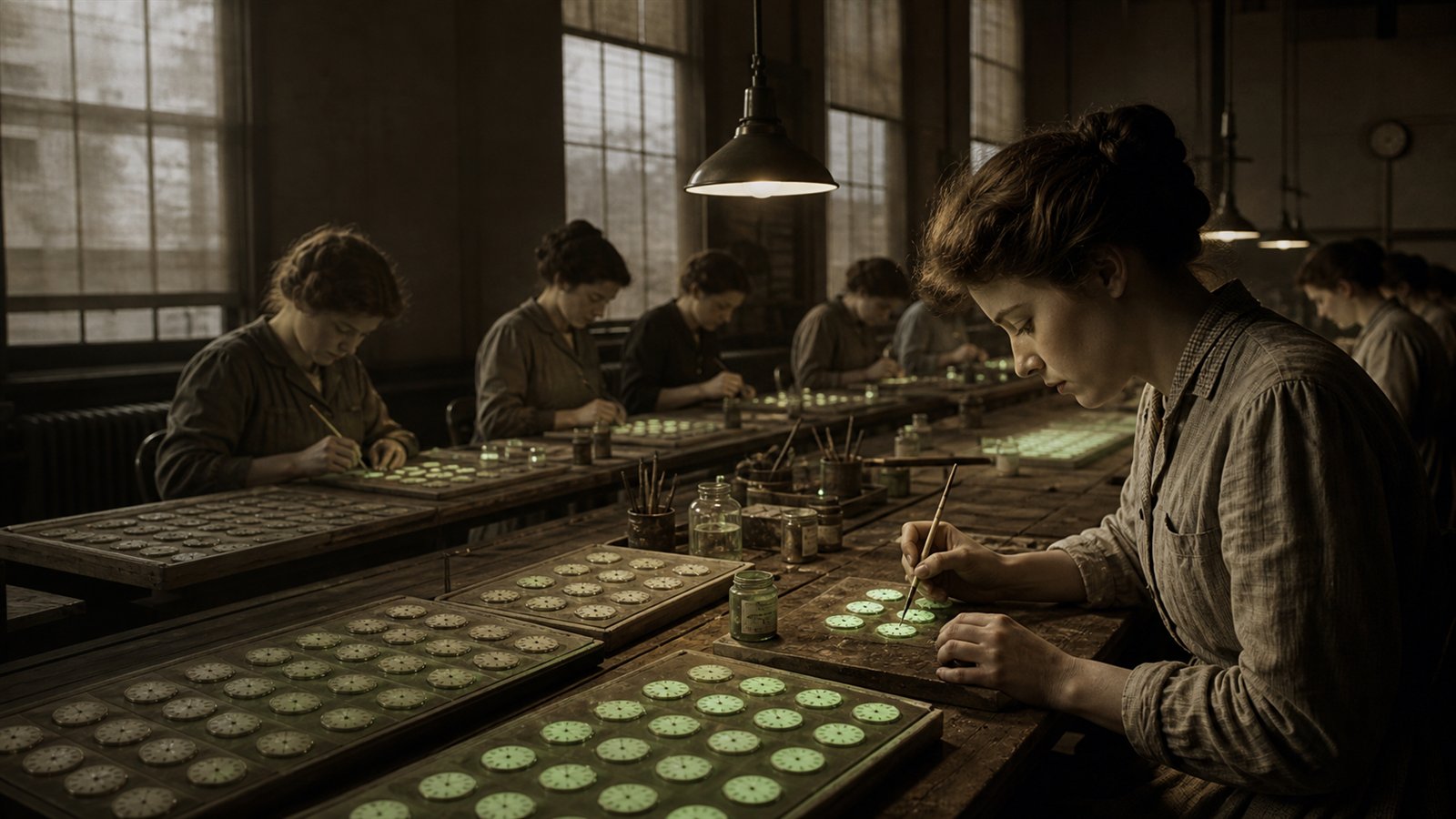
They walked out of the factory glowing in the dark.
The powder clung to their dresses, their hair, their hands. In low light, their outlines still seemed to shine. At the time, it could look amusing. Modern, almost magical.
The light came from radium. And not all of the radium stayed on their clothes.
Some of it went into their mouths.
A job that looked like an opportunity
At the beginning of the twentieth century, radium did not yet sound like an industrial poison. It stood for progress.
After Marie and Pierre Curie announced its discovery in 1898, the element fascinated doctors, researchers, and the public. Its possible use against some cancers was studied seriously. At the same time, salesmen were already putting it in creams, tonics, and products that claimed to restore vitality.
The word “radioactive” did not carry the same warning it does now. It seemed to promise the future.
In Orange, New Jersey, the Radium Luminous Material Corporation made paint that allowed the numbers on watches, clocks, and military instruments to glow. In a trench or a dark room, being able to read the time was genuinely useful.
Someone still had to paint the tiny numerals by hand. The company hired mostly young women, thought to be nimble enough to work quickly without going over the lines. The work was precise, modern, and better paid than many of the jobs then open to women.
On paper, it was a good job.
The most dangerous gesture took a second
The brush was extremely fine, and it quickly lost its point. Its hairs spread. The number became less sharp. The solution taught in the workshop took one movement: place the brush between the lips to bring the point back together.
Lips. Paint. Dial.
Then again: lips, paint, dial.
With every pass, a tiny amount of luminous paint entered the mouth. Once seemed trivial. But the gesture returned all day, dial after dial.
When some of the painters began to worry, they were reassured. They were told the material was harmless and that radium would simply pass through the body.
What makes the story worse is that the danger was not completely unknown. In laboratories where radium was handled, scientists were already using tongs, lead screens, and distance to reduce exposure. Elizabeth Hughes, then working at the Bureau of Standards, had been trained in those precautions. Her supervisor, Noah Dorsey, had himself suffered burns to his hands.
Science did not yet have every answer. It knew enough, however, to protect some specialists. In the workshop, the dial painters were still putting their brushes to their lips.
Mollie Maggia began with a toothache
The first damage did not look like a nuclear disaster. It looked like a dental problem.
Mollie Maggia, who had worked for years at the Orange factory, developed persistent pain in her mouth. Teeth were pulled. The wounds did not heal. More teeth fell out. Her jaw deteriorated so badly that it broke under light pressure during an examination.
She died in 1922.
Other former painters developed symptoms that were hard to connect at first: anemia, extreme fatigue, broken bones, collapsing hips, lesions in the jaw. Many were still very young. And because the illnesses could appear long after a worker had left the factory, the link to the job was easy to dispute.
Radium had found the perfect hiding place.
Chemically, it resembles calcium closely enough for the body to incorporate it into bones and teeth. Once it settles in the skeleton, it does not simply lie there. It continues irradiating nearby tissue, including the marrow that produces blood cells.
The poison was no longer merely around the women. It had become part of their skeletons.
Their bodies kept the proof the company disputed
Grace Fryer, another former dial painter, also became ill. To obtain compensation, being sick was not enough. She had to show that the factory had caused the illness, then find doctors, scientists, and a lawyer able to defend that conclusion against the company.
In 1925, the medical examiner Harrison Martland examined Grace. He asked her to breathe into an apparatus designed to detect radon, a gas created as radium decays. A few months later, he told her that radioactive substances were present in her body and that her illness came from that contamination.
The evidence was as grim as it was difficult to dismiss.
In 1927, Mollie Maggia’s body was exhumed. Measurements found radium in her bones and tissues. Fragments placed against photographic film produced an image without ordinary light: years after her death, her skeleton was still exposing the film.
The material swallowed from the end of a brush was still there.
Five women fought a clock
In May 1927, the lawyer Raymond Berry brought a case against the U.S. Radium Corporation for Grace Fryer and four former colleagues: Katherine Schaub, Quinta Macdonald, Albina Larice, and Edna Hussman.
They were not facing only a company. They were facing time.
Their illnesses were progressing while the case moved slowly. The company challenged the significance of the measurements and sought another delay in the spring of 1928. The move caused an outcry: several of the women might not live long enough to hear a decision.
Another woman then became crucial. Elizabeth Hughes had worked on radium measurements at the Bureau of Standards and later for the company itself. At the workers’ lawyer’s request, she analyzed the breath of the five claimants using an electroscope.
The procedure sounded almost unreal. Each woman breathed through a series of bottles meant to remove moisture and impurities. The remaining gas entered the instrument. If radium in the body released radon, the electroscope would react.
It reacted for all five.
At the April 1928 hearing, the company’s lawyer tried to limit the meaning of those results and challenged Hughes’s qualifications, since she no longer held a regular laboratory post. The judge wanted to hear the rest. Hughes explained her method and recalled that people handling radium in scientific institutions were given safety instructions.
The dial painters had not been given the same protection.
They received a settlement, not an admission
Under pressure from the press, and before a judgment resolved the entire case, the two sides reached a settlement in June 1928.
Each of the five women was to receive $10,000, an annual pension of $600, and payment of certain medical expenses. For women who were seriously ill, it was a concrete victory. It also had limits: the company admitted no responsibility, and most dial painters never received compensation.
Even after the settlement, the scientific fight continued. In November 1928, experts working with the company examined the five claimants again. They ultimately confirmed that all five were radioactive.
The doubt used against them had lost one of its last places to hide.
What the dials finally revealed
The practice of shaping brushes with the lips was abandoned. Studies of the dial painters later helped establish exposure limits and some of the first American standards for protection against radium.
That did not repair their jaws, their bones, or the lives already destroyed. It did not turn every victim into a compensated claimant. But the case made an old industrial strategy much harder to maintain: demanding that workers prove a danger alone when their employer had the means to measure it.
The dials were made to remain readable in the dark.
When the light faded from the watches, the evidence was still shining in their bones.
Discussion
Have something to add?
A detail, a disagreement or a lead worth pursuing? Tell us. Comments are reviewed before publication.