
The Lake That Swallowed a Drilling Platform
On November 20, 1980, a drill jammed beneath a shallow Louisiana lake. Minutes later, a 150-foot rig tipped into the water. Beneath the lake, miners saw water arriving where water had no business being.
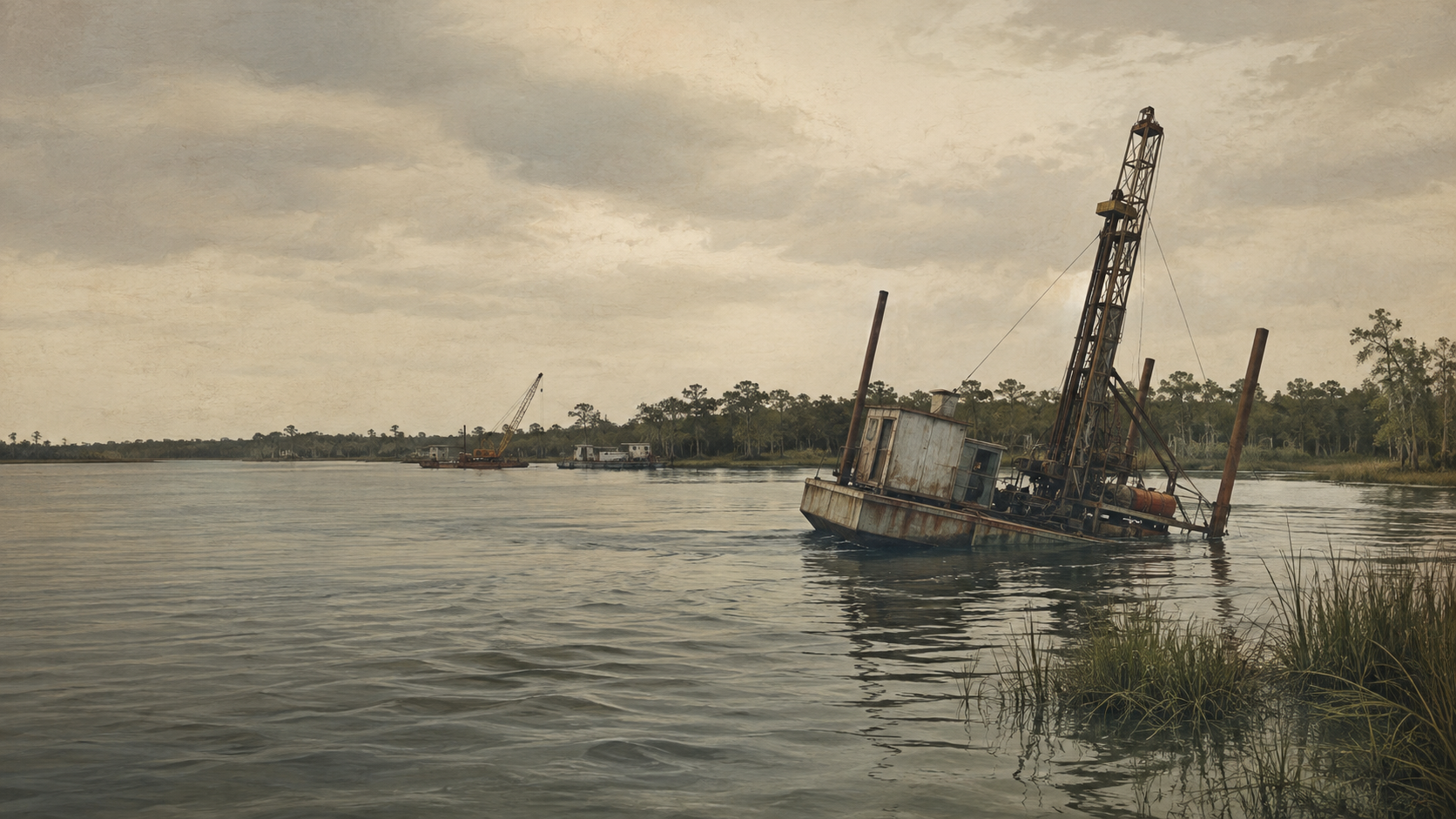
The drill jammed.
On Lake Peigneur, near New Iberia, Louisiana, Texaco’s crew tried to free it. On the morning of November 20, 1980, it still looked like a worksite problem: a tool stuck beneath a few feet of water.
Then came loud pops. The platform began to tilt.
The crew abandoned the derrick and ran for shore. Behind them, a structure about 150 feet tall disappeared into a lake that had previously been only about 11 feet deep.
The water began to spin.
A shallow lake can hide a great deal. This one hid a salt mine.
That contrast explains the violence of the image. The platform had not sunk into a lake that had suddenly become deep; the lakebed itself had stopped being a bed.
At the surface, the ground followed the water
Lake Peigneur was not a vast, mysterious body of water. It was broad, used by fishermen and drillers, but shallow: roughly 1,300 acres and just 11 feet deep before the accident.
Once the derrick vanished, the danger did not stay in one place. The banks began to collapse. Boats, barges, trees and pieces of land slid toward the point where the platform had gone down.
Leonce Viator had been fishing with his nephew, Timmy Dore. In testimony reported by UPI at the time, they saw boats being pulled toward the whirlpool and headed for shore. They tied their own boat to a tree, moved away, and then watched the tree itself get dragged off.
The lake was not merely swallowing objects. It was widening its mouth.
Above ground, no one could yet see the whole mechanism. But hundreds of metres below, other men were beginning to understand that something had reached them.
Beneath the lake, water was the wrong kind of warning
Under part of Lake Peigneur lay Diamond Crystal’s salt mine. Its galleries had been cut deep below the lakebed. On the morning of the accident, miners were working there as usual.
Then muddy water appeared.
It swept equipment along with it. The sound of fuel drums being carried by the current alerted the workers. An evacuation began. Miners headed for the exits while water moved through spaces where they had been working moments earlier.
Four men were in a more distant part of the mine, beyond the reach of the warning signals. Supervisors drove out to collect them. Everyone made it out.
That is the most astonishing part of the story: an entire lake was beginning to pour into a mine, and no one died.
The evacuation was not an abstract miracle. The sounds of the current raised the alarm early enough; the miners knew the escape routes; and someone remembered the four men whom the sirens had not reached. The accident destroyed the mine, but it did not trap its workers inside.
The explanation was brutally simple. The drilling had opened a path between lake and galleries. The companies later disputed exactly how it happened, including the well’s location and the maps used. But the physical result was already unavoidable: water could reach salt.
And water meeting salt does not leave a hole the size of a drill bit.
The hole grew while the lake drained
Water rushed into the galleries and dissolved salt as it went. The opening widened. The wider it became, the more water could pass through; the more water passed through, the more salt dissolved.
That loop turned a drilling accident into a landscape disaster.
At the surface, the lake level fell. Mud appeared. The whirlpool became powerful enough to pull in 11 barges, a tugboat, another drilling rig, a loading dock, and large sections of land and trees.
The list sounds unreal, but it does not describe a fixed hole. The landscape kept moving as the water found more salt to dissolve. A bank that still held could fail minutes later.
Then came a second absurdity, almost as hard to picture as the first.
The Delcambre Canal normally carried water away from the lake toward Vermilion Bay and the Gulf of Mexico. Once Lake Peigneur fell below the bay’s level, the flow reversed.
Water began running back toward the lake.
It came in from the Gulf and dropped into the emptied basin, which was still feeding the underground galleries. For a time, the accident created its own waterfall: not a river running to the sea, but the sea running into a hole beneath a lake.
The lake came back. The mine did not.
Eventually, the galleries filled. Water stopped vanishing beneath the lake and the level rose again. Evacuated families waited for the ground to stabilize before returning home about a week later.
Lake Peigneur reappeared, but it was no longer the same lake. The former shallow freshwater lake had become far deeper, connected differently to its surroundings, and filled with saltwater from the Gulf.
The mine was gone.
For its employees, the disaster did not end when the water came back. The company that operated the mine had to look for jobs for people whose workplace still existed physically but had become unreachable. The companies’ dispute ended later in a settlement. No map and no payment could bring the galleries back.
The disaster did leave one final image so strange it sounds invented. Of the 11 barges swallowed by the whirlpool, nine rose back to the surface as the water returned.
The lake gave back part of what it had taken.
Not the mine.
Sources and checks
- University of Louisiana at Lafayette — disaster archives — lake dimensions, sequence, resurfaced barges, outcome, and new environment.
- Stafford et al. — Jefferson Island evacuation case study — mine chronology and evacuation.
- UPI, November 21, 1980 — eyewitness accounts.
- UPI, 1983 settlement — dispute around the cause.
Leave a Reply