
The day the United States detonated a nuclear bomb in space
On the night of July 8, 1962, people in Hawaii watched the sky turn colors as if it had opened above them. The explosion was more than 800 miles away. Its effects would outlast the light.
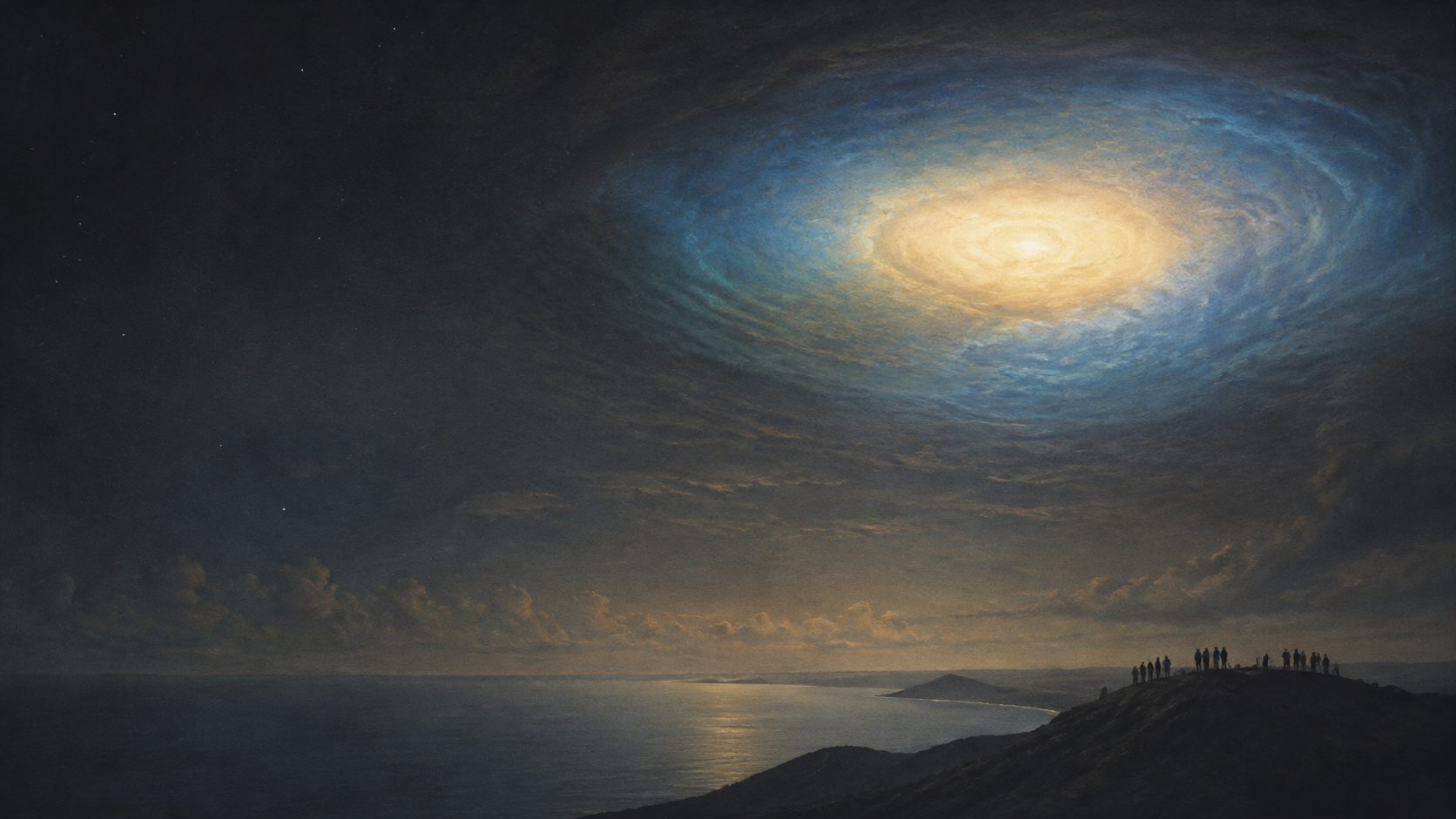
Over Hawaii, the sky turned green, then yellow, then red.
Kathleen Norris was still in high school. She and her brother drove up to Tripler, above Pearl Harbor, to watch a test announced over the Pacific. Residents had been told to find a clear view. The scheduled time was 11 p.m.
Far away, above Johnston Atoll, a Thor rocket carried a 1.4-megaton thermonuclear weapon. It detonated at an altitude of about 400 kilometres. In Honolulu, it was still July 8, 1962. In Universal Time, July 9 had already begun.
Norris would later describe a green flash, followed by a sky that turned yellow and red before going dark again.
From the island, it looked like a finished event: a fire far away, a few extraordinary minutes, then night taking its place again. In fact, the artificial aurora remained visible for more than seven minutes. And there was no conventional fireball: at that altitude, there was almost no air.
That was not what happened.
An explosion that reached an island without touching it
Starfish Prime was not an underground test. It was not even an atmospheric explosion in the ordinary sense. The bomb went off in space, more than 800 miles from Hawaii.
Yet streetlights on Oahu went out and electrical systems were disturbed. U.S. Air Force historical records list the simultaneous failure of 30 strings of streetlights. No blast wave had crossed the Pacific. The effect came from an electromagnetic pulse: an extremely brief disturbance produced by the explosion, capable of creating surges in systems far away.
The flash in the sky was only the visible part of the experiment.
The military wanted to study what such an explosion could do to communications and equipment. Ships, aircraft, and instruments were spread across the Pacific to follow the test. But Starfish Prime did not only affect cables and streetlights for one night. Much higher up, it also deposited particles that did not immediately fall away.
The sky kept what it had received
Earth’s magnetic field naturally traps energetic particles in the Van Allen belts. Starfish Prime added another population of particles to that environment.
From the ground, the event was gone in less than an hour. In orbit, those particles remained trapped. Again and again, they crossed the paths of satellites.
That change does not show up in a photograph. It shows up in components: solar cells losing output, transistors receiving radiation doses they were not designed for, systems expected to keep working where no engineer can reach them.
This was not like an ordinary explosion. There was no flame left to avoid, no falling debris. There was an environment made more hostile to machines that barely existed yet.
The day after the test, one of those machines set out for that altered space. It is the kind of coincidence that makes Starfish Prime feel almost absurd: humanity tested a weapon in space just as it was beginning to depend on machines placed in that space.
Telstar arrived after the bomb
On July 10, 1962, a Delta rocket lifted off from Florida carrying Telstar 1. Built by Bell Laboratories, the satellite was designed to relay television, telephone calls, and data between North America and Europe.
It had not even been in orbit when Starfish Prime exploded.
Days later, Telstar helped carry the first live television pictures across the Atlantic. A U.S. flag filmed in Maine could be seen in France. At that moment, the satellite seemed to embody what space promised: a suddenly smaller Earth, linked by machines above it.
But Telstar was flying through a region that was no longer the same as it had been days earlier.
Another satellite, Ariel 1, had already been in orbit during the explosion. Soon afterward, its transmissions became erratic. Technical studies examined its declining solar-cell output and the radiation environment it encountered.
Telstar’s problems followed. In the autumn, some commands stopped working reliably. Engineers tried to reproduce the failures on the ground, then altered the instructions sent to the satellite in an effort to work around damaged components. Telstar fell silent, returned briefly in early 1963, and then stopped responding for good on February 21.
It had been launched seven months earlier.
A trace left above Earth
It would be too simple to say that Starfish Prime alone destroyed every satellite that failed in that era. Technical causes overlapped, and later Soviet tests also altered the space environment.
But the central fact is well documented: the explosion created an artificial radiation belt that continued to affect near-Earth space for years.
People in Hawaii had watched a spectacular sky. Engineers had to learn that a weapon tested over the Pacific could reach machines launched later from Florida.
Night had returned over Hawaii.
Up there, the explosion had not finished.
Sources and checks
- Starfish Prime preliminary report, 1962 — test setting and observations.
- NASA — space-weather events linked to human activity — trapped particles and lasting effects.
- NASA — Telstar 1 history — launch, purpose, and first links.
- NASA technical reports on Ariel and Telstar — studied satellite effects.
Leave a Reply