
The Dam That Held While the Mountain Killed the Valley.
In 1963, the Vajont Dam stayed standing. The disaster came from the mountain above the lake, and from the wave it threw into the valley below.
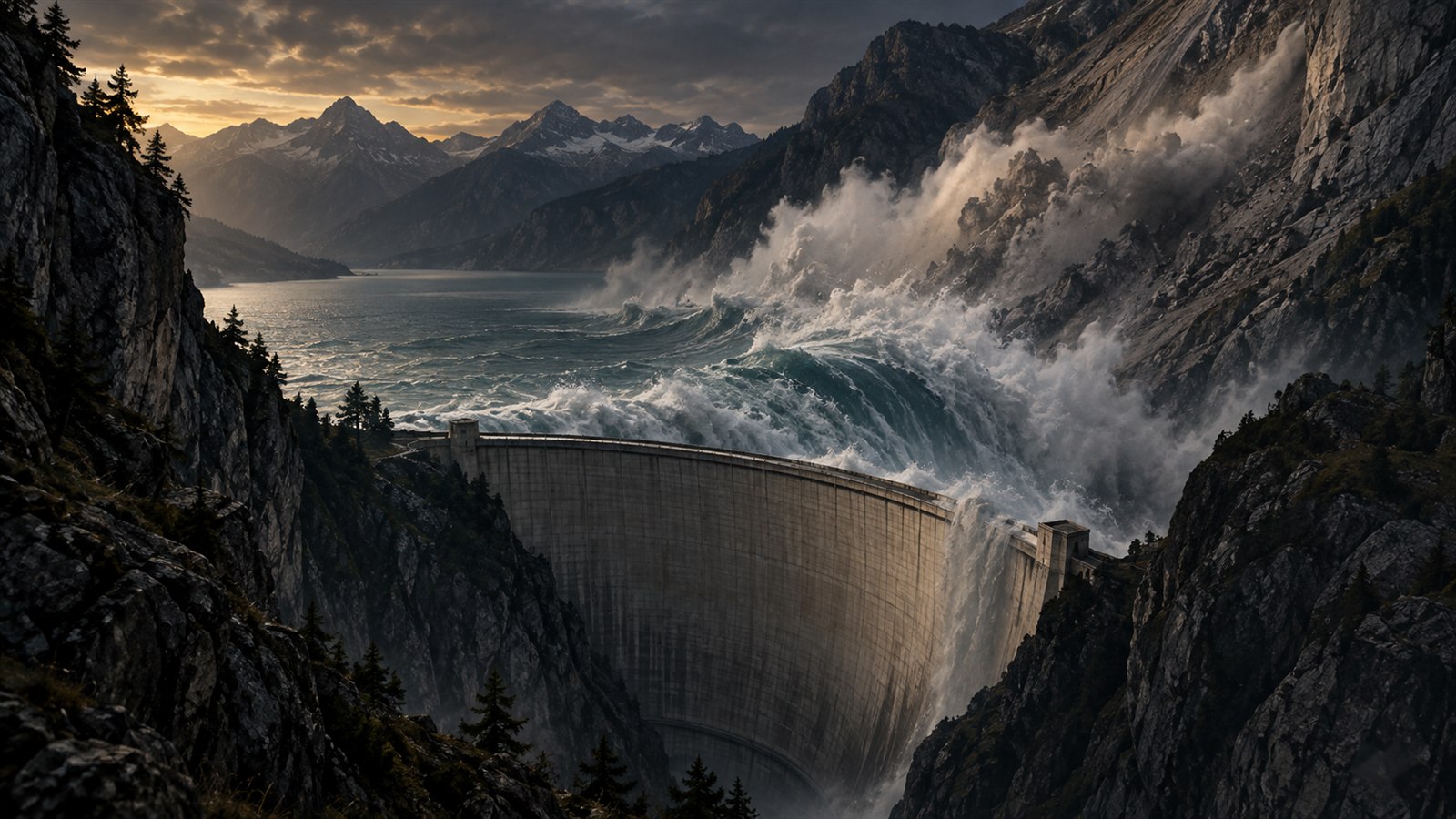
The next morning, the wall was still there.
From a distance, that is almost what makes the story harder to believe. A dam more than 260 meters high, built in a narrow Italian gorge, had just become linked to one of Europe’s worst industrial disasters. Villages had vanished. A valley had been devastated. Entire families were gone.
And yet the concrete wall had not collapsed.
This was not the familiar image of a dam cracking under pressure. It was not a breach opening and releasing a lake. It was not the simple story of a structure that failed.
At Vajont, the trap was stranger.
The dam held.
The mountain fell into it.
The slope was already moving
In northern Italy, the Vajont stream runs through a narrow valley below steep slopes. In the late 1950s, the place became the setting for an enormous project: a high arch dam that would hold back an artificial lake and feed a wider hydroelectric system.
On paper, it looked like modern engineering at its most confident. Postwar Italy needed energy. The mountains offered height, water and tight valleys. A well-placed dam could turn a landscape into an electrical machine.
But a dam does not hold back only water.
It depends on everything around it.
Above the future reservoir stood Monte Toc. After the disaster, the name would become infamous, but the slope had not appeared suddenly in the story. Before the catastrophe, it was already causing concern. Ground movements were observed. Cracks appeared. In 1960, a significant landslide entered the reservoir.
The mountain was not still.
Filling a lake is not just adding water
A reservoir changes the balance of a valley.
When the water rises, it presses against slopes. It enters fractures. It alters pressure inside rock and soil. When the level falls, the sides of the valley do not necessarily return to the way they were before. What looks like a waterline on a map can become, inside an unstable mountain, a way of touching everything that holds it together.
At Vajont, the water level rose, fell and rose again. Engineers and authorities watched the slope. They measured. They interpreted. They tried to control the situation by managing the reservoir.
The problem is that a mountain does not behave like a valve.
You can slow down the filling of a lake. You can record a rate of movement. You can compare numbers. But if the volume ready to move is enormous, if the sliding surface is dangerous, if water helps trigger the failure, the catastrophe no longer needs a weak dam.
It only needs a lake in the wrong place, at the wrong level, below the wrong slope.
The evening Monte Toc came down
On the evening of October 9, 1963, the side of Monte Toc finally failed.
This was not a small rockfall or a limited collapse. It was a massive body of material, commonly estimated at about 270 million cubic meters, sliding into the reservoir. A piece of mountain moved at once, fast enough to turn the lake into a weapon.
The water had nowhere to disappear.
It received the mountain, rose, compressed and searched for a way out. A gigantic wave formed. Part of it surged toward villages near the lake. Another part overtopped the dam.
The image is almost absurd: the wall remained standing, but the water went over it.
Downstream, Longarone and nearby settlements did not face a slow flood. They were struck by water and displaced air with extraordinary violence. Houses were swept away. Lives were erased. In some places, the disaster moved faster than the chance to understand what was happening.
The official death toll is 1,917. Hundreds of bodies were never recovered.
And in the middle of the destruction, the dam remained.
The detail that makes it worse
When people imagine a dam disaster, they usually picture a wall breaking. In a way, that is almost comforting, because the cause appears visible: the concrete failed, so the water escaped.
Vajont forces a different kind of attention.
The concrete was impressive. Technically, the dam did not suffer the dramatic breach people might expect. But the larger system — dam, reservoir and mountain — was far more fragile than the wall by itself.
That is what makes the story more than a local tragedy. It reveals a mistake in how danger is seen. You can build something strong in a place that is not. You can succeed at the main object and miss the setting that makes it dangerous. You can believe you are controlling a risk because you are measuring it, while actually recording its progress.
Danger does not always arrive as a badly made part.
Sometimes, every part seems to hold on its own.
Then they are assembled in the wrong landscape.
A disaster that needs no exaggeration
Vajont does not need added drama. It already contains too much.
A giant dam. An unstable mountain. Visible warnings. An artificial lake. A wave passing over an intact wall. Nearly two thousand dead. And after all that, the sentence that has to be repeated so the story is not told incorrectly: the dam did not break.
That is exactly what makes it so powerful.
The disaster did not come from one instant when everything snapped. It came from a chain of decisions in which people believed a mountain could be managed like a construction site. The water was held back. The numbers were followed. The levels were adjusted. The slope was expected to remain inside an acceptable range.
But a valley is not a spreadsheet.
On the night of October 9, 1963, Vajont showed that a structure can be strong and a project can still be catastrophic. The wall resisted. The mountain reminded everyone that it was not part of the concrete.
And that may be the most disturbing lesson of the story: sometimes, the thing that kills is not the thing that gives way.
It is the thing people thought they understood.


Leave a Reply