
The Lake Never Overflowed. By Morning, Entire Villages Were Dead.
The houses were still standing. The roads were untouched. But almost nothing moved in the valley below Lake Nyos.
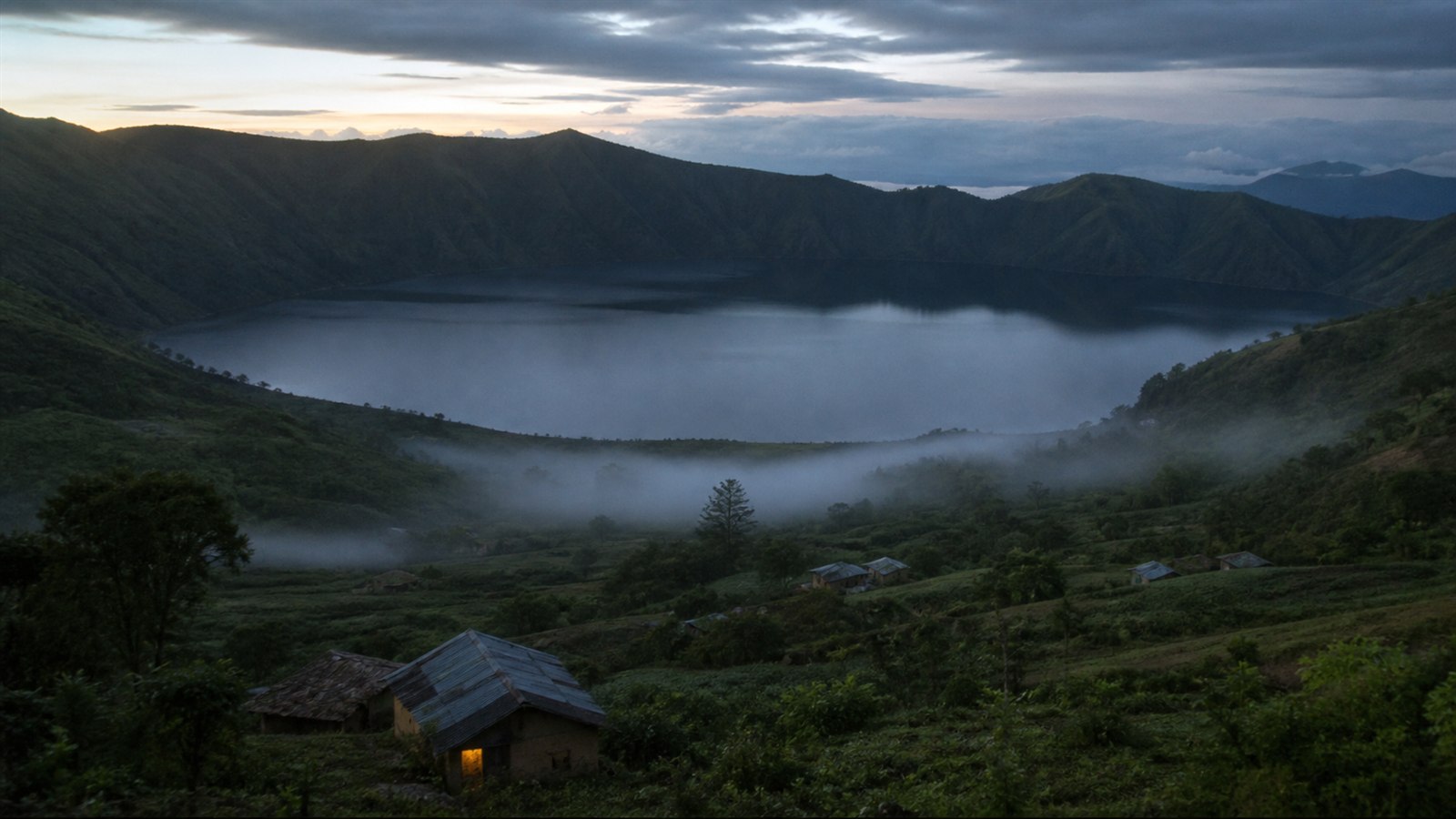
On Friday, August 22, 1986, a man regained consciousness near the village of Nyos in north-west Cameroon. Morning light had returned. Around him, the landscape seemed to have passed through an ordinary night.
The houses had not collapsed. The trees had not burned. No torrent had carried away the paths. Yet bodies lay inside homes, along tracks and in the middle of livestock pens.
Entire families appeared to have fallen asleep at the same moment. Cattle had dropped where they stood. Even insects seemed to have vanished from some places.
The few survivors emerged with the same broken memories: a distant noise, sometimes a strange smell, and then nothing. Some had been unconscious for hours. Others woke too weak to stand.
Across the valley, nobody could see what had killed them. That was precisely the problem.
The night left no disaster scene
Until then, Lake Nyos attracted little attention beyond the region. It lies inside an old volcanic crater, surrounded by steep hills and farmland. Its dark water fills a basin almost two kilometres long.
On the evening of August 21, residents said they heard a rumble. Others described a rush of air. In the darkness, a white or misty mass seemed to slide from the lake into the low valleys.
People on higher ground were sometimes spared. Below them, death followed the contours of the land.
As the hours passed, the first people arriving from neighbouring villages found Nyos, Subum, Cha and several smaller settlements silent. Rescue workers entering the area found no characteristic injuries, no sign of an explosion and no volcanic ash capable of explaining the devastation.
The toll accepted by officials and scientific teams would reach about 1,746 deaths. Thousands of cattle and other animals died as well. Some survivors had blisters or lesions, but many victims showed no visible trauma.
Something had crossed the valley without knocking down a single house.
The first clues lay at the water’s edge
When scientists arrived, the lake bore unusual marks. Its colour had changed in places. Vegetation near the shore had been flattened. The water level appeared to have shifted, yet there was no lava flow and the natural dam holding back the lake was intact.
Theories multiplied: an eruption, volcanic gas rising directly from the ground, poisoning, perhaps even a weapon. None fitted everything the scene revealed.
Medical accounts pointed in one direction. Many people had collapsed before they could flee. Unconsciousness came suddenly. The victims had not been burned; they had stopped breathing.
Researchers began measuring the deep water. The farther down they went, the more abnormally high the concentration of dissolved gas became.
The lake did not contain only water at the bottom. For years, it had been storing something invisible from the shore.
The crater worked like a sealed bottle
Below the lake, volcanic activity releases carbon dioxide. The gas slowly rises through the ground and dissolves in the deep layers of water, where the pressure is high.
In an ordinary lake, seasonal temperature changes periodically mix the water. At Nyos, the climate, the depth of the crater and the stability of its layers prevent a complete turnover. The gas-rich water remains trapped at the bottom.
Year after year, the reserve grows. It resembles a bottle of carbonated drink filled far beyond reason but never uncapped.
On the evening of August 21, the balance broke. A mass of deep water began to rise. As the pressure fell, the carbon dioxide formed bubbles. Those bubbles made the column of water lighter, causing it to rise faster and release still more gas.
The process began feeding itself.
An immense quantity of carbon dioxide erupted from the lake in a very short time. Scientific estimates run as high as roughly one cubic kilometre of gas. The invisible wave cleared the crater rim, spread along the ground and poured into the valleys.
CO₂ is neither a mysterious poison nor a rare gas. We exhale it with every breath. But at high concentration, it displaces oxygen. And because it is denser than air, it hugs the ground instead of dispersing at once.
In the low points, the valley became a sealed room from which someone had removed the air.
We understand the mechanism, not the first push
Scientists gave the phenomenon a name: a limnic eruption. Gas accumulated at the bottom of a lake is released suddenly and transforms the surrounding atmosphere.
The general mechanism is now well established. What started the initial upward movement is much less certain.
A landslide may have disturbed the deep layers. Unusual cooling, intense rain, a small earthquake or a new pulse of gas from below have also been proposed. No explanation has closed the case for good.
That is not a minor detail. As long as carbon dioxide continues entering the lake from below, the reservoir can build up again.
A few dozen kilometres away, Lake Monoun had already killed 37 people in similar circumstances in 1984. At the time, the event was poorly understood. After Nyos, the two disasters stopped looking like unrelated anomalies.
The gas cloud followed the valleys and collected in low areas. Distance, altitude, air currents and the shape of individual houses therefore produced enormous differences over only a few hundred metres. Some people also lost consciousness before reaching a fatal exposure and woke after the cloud dispersed.
To stop the lake doing it again, engineers had to let it breathe
After the disaster, thousands of residents were displaced. The most exposed villages were emptied, but one question remained: how do you neutralise an entire lake without triggering the very release you are trying to prevent?
The answer looked almost like a laboratory experiment. Engineers installed a long vertical pipe reaching into the deep water. A pump started the flow. Then the gas itself took over: once bubbles began to form, they continuously drove the water towards the surface.
Above the lake, the pipe produced an enormous white jet. It was not a decorative fountain. It was pressure trapped beneath the crater finally escaping under control.
The first permanent system entered service in the early 2000s. More pipes were later added to accelerate degassing. Lake Monoun received similar treatment.
Scientists also monitor the natural dam holding Lake Nyos back. If it weakened, flooding could disturb the lake’s layers again. The danger did not vanish with the burial of the last victim; it merely changed form.
The lake is calm again. Nobody sees it the same way
The pipes have greatly reduced the amount of dissolved gas in the depths. Residents have returned to the region despite the abandoned land, the memories and the uncertainty.
Lake Nyos is not the only lake capable of storing carbon dioxide. Lake Kivu, between Rwanda and the Democratic Republic of the Congo, also holds immense gas reserves beside far larger populations. Its behaviour is different and it is monitored in its own way, but Nyos changed how researchers assess the risk.
Before 1986, calm water could feel reassuring. After that night, we know a lake can hold years of pressure beneath its surface and release it in minutes.
Lake Nyos never needed to leave its crater. It only had to exhale.


Discussion
Have something to add?
A detail, a disagreement or a lead worth pursuing? Tell us. Comments are reviewed before publication.