
The Pentagon Received This Plan in 1962. Almost No One Saw It for Thirty Years.
Fifteen pages proposed manufacturing the anger needed for a war. The signatures at the bottom did not belong to extremists.
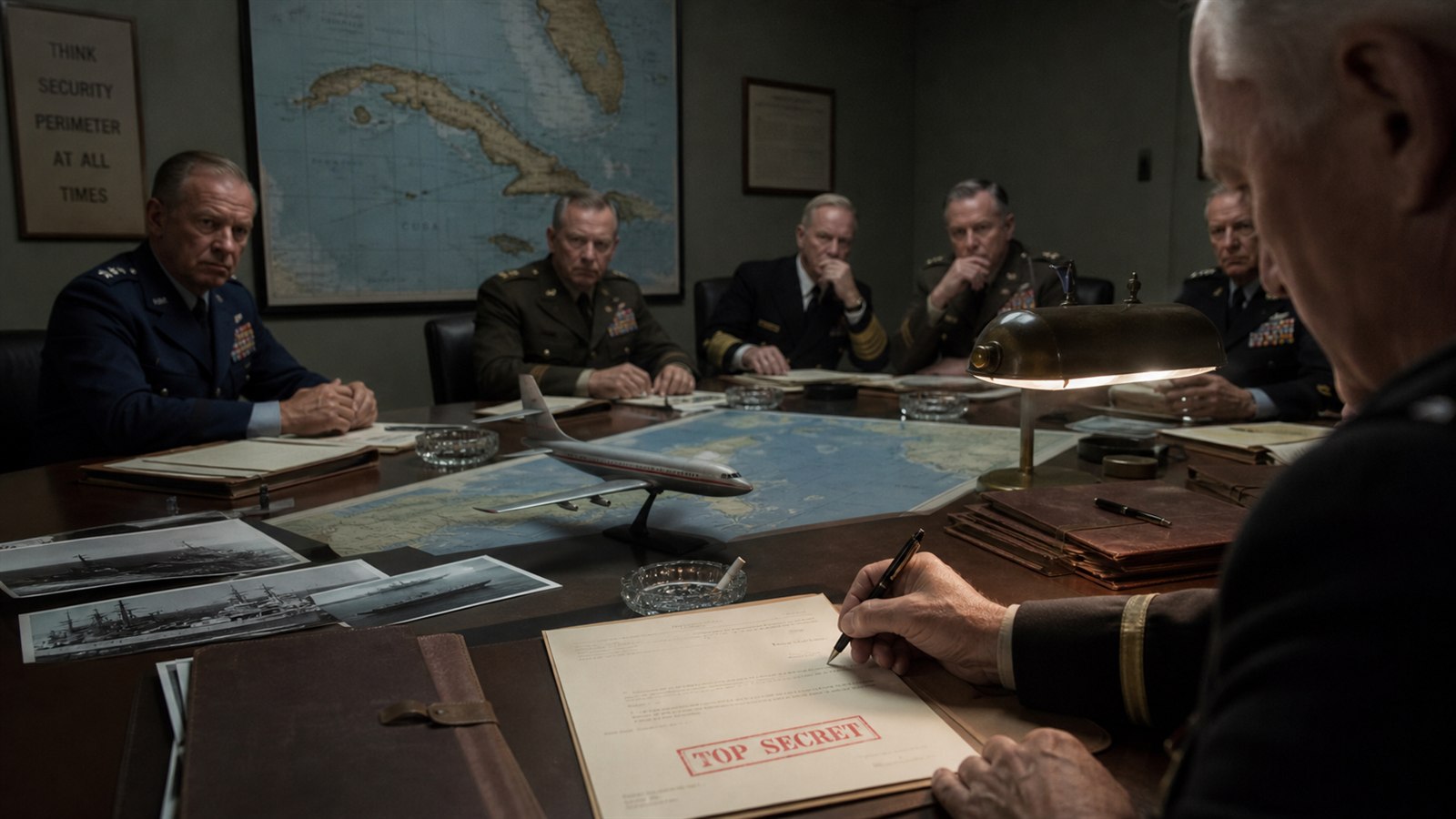
The document is dated March 13, 1962. At the top of its first page, a dry administrative title promises nothing more than “justification for US military intervention in Cuba.”
The tone is cold, almost routine. It discusses meetings, responsibilities and schedules. Then the sentences begin describing events that never happened.
An American ship could explode in Guantánamo Bay. A civilian aircraft could be shot down. Terror attacks could strike American cities. Casualty lists could be released to the press.
Each time, Cuba would be blamed.
This was not a plan found in the basement of a clandestine group. The highest-ranking military leaders in the United States approved it before sending it to the Secretary of Defense.
After the Bay of Pigs, Washington still wanted Castro gone
Fidel Castro took power in Cuba in January 1959. Within a few years, his government drew closer to the Soviet Union, nationalised American interests and became an obsession for part of the US state apparatus less than 200 kilometres from Florida.
In April 1961, a CIA-backed force of Cuban exiles landed at the Bay of Pigs. The operation was meant to trigger an uprising. It collapsed in less than three days.
The defeat humiliated the Kennedy administration, but it did not end plans against Castro. By the end of the year, the White House had launched Operation Mongoose: sabotage, psychological warfare, intelligence gathering and support for covert action intended to weaken the Cuban regime.
Military leaders nevertheless faced a broader problem. Invading Cuba without a prior attack would expose the United States to international condemnation. They needed a reason strong enough to persuade the American public, allied governments and perhaps the Organization of American States.
The task was no longer merely to prepare a war. It was to prepare what the public would have to believe before it began.
General Lemnitzer sent fifteen pages of “pretexts”
The Chairman of the Joint Chiefs of Staff was Lyman L. Lemnitzer. A four-star general, he presided over the body that brought together the heads of the US armed services.
A memorandum bearing his signature was sent to Secretary of Defense Robert McNamara. Its codename would later appear in the archives: Operation Northwoods.
The document explained that the Joint Chiefs had considered actions capable of giving the United States a “legitimate justification” to intervene in Cuba. It added that the proposals could be carried out in ways that made the Cuban government appear to be the aggressor.
This was not an idea scribbled in the margin of a meeting. The text set out several scenarios, their political effects and what would be required to stage them.
The authors were seeking a precise formula: an attack dramatic enough to produce outrage, but controlled enough to deliver the desired military result.
At Guantánamo, the incidents would be manufactured one by one
The first group of proposals concerned the US naval base at Guantánamo, on Cuban territory.
Men in Cuban uniforms could start riots near the entrance. Ammunition could explode. Aircraft could be sabotaged. Mortar shells could fall on the base. The United States would then capture fake saboteurs and present the incidents as a coordinated attack.
The document also suggested blowing up an American ship in the bay, followed by public funerals for supposed victims. It explicitly invoked the USS Maine, whose explosion in Havana had helped trigger the Spanish-American War in 1898.
Other scenarios widened the target area. A boat carrying Cuban refugees could be sunk, “real or simulated.” Attacks might target exiles in Florida. A campaign of terror could strike Miami, other Florida cities and even Washington.
The text did not always specify whether the victims would be real. That is exactly what makes it so chilling: some lines speak of simulated damage; others leave the boundary hidden in administrative fog.
The aircraft scenario turned passengers into ghosts
The most elaborate proposal involved a civilian airliner.
An aircraft actually owned by the CIA could be repainted to resemble a commercial flight. Carefully selected passengers would board under false identities. After a stop, the real aircraft would descend to low altitude and secretly land at a military base.
At the same time, an identical drone would continue over Cuba. It would broadcast a distress call saying that Cuban fighters were attacking it, then be destroyed by remote control.
To the outside world, an aircraft full of American students or travellers would have vanished in flight. Civilian radios would have captured its final call. Passenger lists would exist. Families and the press would receive a story already prepared for them.
In reality, the supposed dead would be alive and hidden. Their disappearance would still manufacture precisely the emotion the plan required.
Northwoods proves that the US Joint Chiefs of Staff approved and transmitted proposals for fabricated pretexts in 1962. It does not prove that these operations were carried out. The plan was not adopted, and none of the scenarios in the memorandum was authorised in that form.
The administration did not give the green light
Lemnitzer delivered the proposals to McNamara amid tension between the military leadership and the White House. President John F. Kennedy had already proved far more reluctant than some of his generals to deploy the armed forces directly against Cuba.
The Northwoods memorandum never became an operation. The administration did not authorise it. A few months later, Lemnitzer left the chairmanship of the Joint Chiefs before becoming NATO’s Supreme Allied Commander in Europe.
It would be too easy, however, to tell the episode as one general’s isolated suggestion, followed by his immediate removal. Every member of the Joint Chiefs approved the document. It was collective work at the summit of the military establishment.
Pressure on Cuba continued. In October 1962, the missile crisis brought the United States and Soviet Union close to nuclear war. Operation Mongoose continued for a time, with its sabotage plans and clandestine methods.
For decades, the public knew nothing of these pages
Northwoods remained classified for more than thirty years. It was finally released in the 1990s during declassification work related to records on Kennedy’s assassination.
Its publication immediately fed the most extravagant stories. The danger then was to make the document say more than it contained, or use it as automatic proof of every conspiracy imagined since.
It does not need that.
Its fifteen pages are enough. They show that, at a moment of extreme confrontation, the most senior military leaders in a democracy seriously considered manufacturing attacks, victims and evidence to make a war politically acceptable.
Northwoods never happened. But it was written, reviewed, approved and signed.
Sources and verification
- National Security Archive — original Joint Chiefs memorandum, March 13, 1962
- Declassified document — Justification for US Military Intervention in Cuba
- National Security Archive — Operation Mongoose documents
- US National Archives — declassified JFK records
- Office of the Historian, US Department of State — diplomatic documents on Cuba
Discussion
Have something to add?
A detail, a disagreement or a lead worth pursuing? Tell us. Comments are reviewed before publication.