
He Invented a Country. Then He Sold Its Land to Real People.
Two ships crossed the Atlantic for a capital drawn on maps. As the coast came into view, something became impossible to explain.
In March 1823, the Kennersley Castle approached the coast of Central America. Nearly 200 passengers crowded onto the deck. After almost two months at sea, they were finally looking for St Joseph, the capital of Poyais.
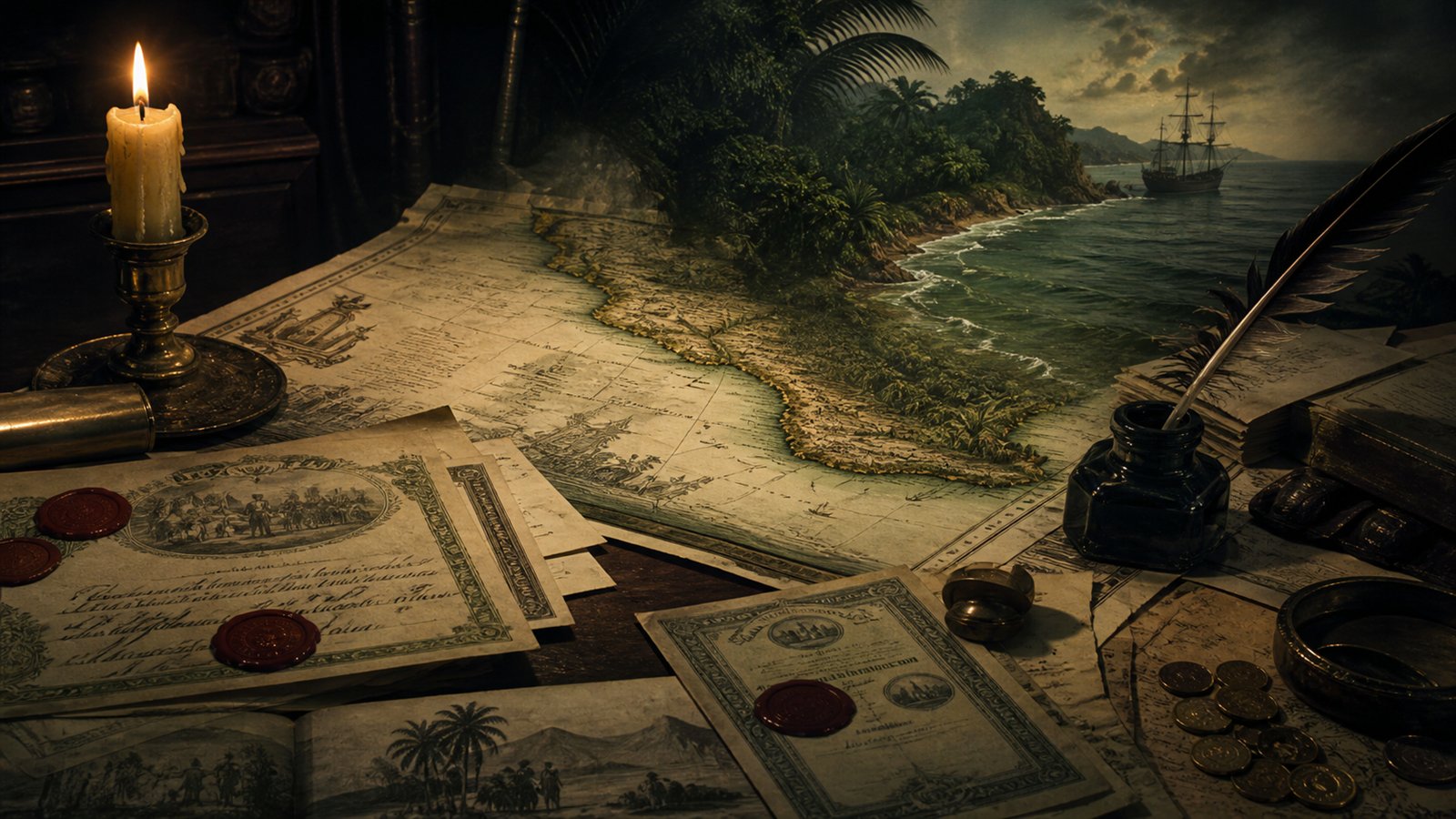
The maps promised a harbour, public buildings, houses and even an opera house. Some of the travellers were meant to become civil servants, officers or merchants. Others already owned land there, its boundaries carefully marked on signed certificates.
From the ship, no one could make out a church tower. No pier reached into the water. As the coast drew closer, the city still refused to appear.
The only people who came to meet them were living in tents on the beach. They were not a welcoming committee. They were the survivors of an earlier ship that had arrived months before.
They had been looking for St Joseph too.
To understand how entire families came to cross the Atlantic for an invisible capital, we need to go back two years to London, where a man had introduced himself as the prince of a country no one had heard of.
In London, a prince appears from nowhere
Gregor MacGregor had exactly the kind of past that made people believe him. The Scotsman had served in the British Army, fought in Latin America and moved among heroes of the wars of independence. He had even married a cousin of Simón Bolívar.
When he returned to Britain in 1821, he no longer presented himself as an ordinary soldier. He insisted on being called the “Cazique of Poyais,” a title he was happy to translate as “prince.”
His story began with something real enough to survive the first questions. The year before, the Miskito king George Frederic Augustus had granted him a vast territory on the Mosquito Coast, around the Black River. The legal reach of the concession was shaky, but the paper existed.
MacGregor supplied everything else.
He described a prosperous state covering millions of acres, complete with a government, an army and a capital called St Joseph. Its soil was fertile, its rivers rich in gold and its tropical climate remarkably healthy. The city supposedly had streets, banks, official buildings and a theatre.
In London drawing rooms, his uniform, his manners and his genuine military campaigns silenced many doubts. An aristocrat lent him a country estate. The Lord Mayor of London held a banquet in his honour. Poyais had just acquired the thing an imaginary country needs most: important people behaving as though it were real.
He created everything a lie needs to display
MacGregor did not merely describe his country. He gave it a form people could touch.
A guidebook running to hundreds of pages, published under the name Thomas Strangeways, described the coast, its crops and resources, and the best way to settle there. Maps marked the borders. A flag was designed. Banknotes were printed in Scotland.
Prospective settlers could buy 100 acres for £11. They could also pay for a position in the new state’s government, army or bank. City investors, meanwhile, were offered a £200,000 government loan issued in the name of Poyais.
The documents were convincing enough to survive for centuries. The British Museum still holds a Poyais bond issued in London. The National Library of Scotland owns a certificate granting 200 acres and bearing MacGregor’s signature.
The fake country had already produced real archives. All it lacked was a population.
The first ship leaves without its prince
On September 10, 1822, the Honduras Packet sailed from London with around 70 settlers. MacGregor waved them off. He did not go aboard.
The passengers included craftsmen, families, professionals and men promised official positions. Some had sold everything they owned. Others had converted their savings into Poyais dollars, a currency perfectly useful in the country awaiting them — and almost nowhere else.
When the ship reached the mouth of the Black River in November, the passengers found neither harbour nor capital. They unloaded their supplies, pitched tents and waited. Perhaps the local authorities were merely late. Perhaps the city lay farther inland. Perhaps the next ship would bring answers.
In January 1823, the Kennersley Castle set sail from Leith, Scotland. The passengers packed aboard knew nothing of the first expedition. When they arrived in March, the people on the beach had still not seen St Joseph.
At that moment, the newcomers might have turned back. But the ship unloaded them and their belongings, then continued on its way. Two groups of settlers were now alone before a jungle no document had taught them how to survive.
Paper can no longer feed anyone
The settlers tried to turn the camp into a settlement. They built shelters, organised their supplies and waited for the promised shipments from Britain.
Nothing came.
The rainy season drew near. Insects overran the camp, provisions spoiled and disease spread. Poyais dollars could buy neither medicine nor food nor passage to somewhere safer.
James Hastie, one of the settlers, published his account as early as 1823. He described sickness and despair becoming so widespread that hardly anyone still had the strength to act. Historical studies also mention suicides and several desperate attempts to escape the coast.
In the spring, a schooner sent from Belize finally discovered the camp. It evacuated the survivors over several journeys. For many, rescue came too late: of the roughly 250 people who had sailed with the first two expeditions, more than 150 died there or soon after being evacuated.
The territory was not an empty space on the map. MacGregor’s claim rested on a concession from a Miskito ruler in a region that was already inhabited and contested. What he invented was the prosperous state, its capital, institutions and infrastructure — and the safety promised to its settlers.
Meanwhile, Poyais moves to Paris
When news of the disaster reached Britain, MacGregor did not wait for every question to catch up with him. In the autumn of 1823, he moved to France.
The most astonishing part was not his escape. It was what he did next: he started again.
A Poyais constitution appeared. New financing was sought. French recruits were signed up for another expedition. Their passport applications, however, drew the attention of officials who went looking for the mysterious country on their own maps.
MacGregor was arrested in December 1825 and tried for fraud and conspiracy. With insufficient evidence to connect him clearly to every stage of the scheme, he was acquitted and released.
He returned to London. In 1827, a new £800,000 bond was offered in the name of Poyais. Land certificates were still circulating the following year. The country had already killed some of its first inhabitants, but on paper it continued selling land.
He did not need everything to be false
MacGregor succeeded because he assembled truth and invention with far more care than an ordinary liar.
The wars of independence really had created new Latin American states. Those governments really were borrowing in London and seeking settlers. MacGregor possessed genuine military experience, a genuine territorial concession and genuine connections.
Then came the objects: maps, money, uniforms, land deeds, a guidebook and bonds. None proved on its own that a city was waiting for the travellers. Together, they made it feel almost embarrassing to keep asking questions.
MacGregor ended his life in Venezuela, where his former military service earned him citizenship and a pension. He died in 1845 without ever being convicted over Poyais.
Poyais never existed. The people who died trying to live there did.

Sources and verification
- British Museum — Poyais government bond, 1823
- National Library of Scotland — Poyaisian Republic land certificate
- Library of Congress — Sketch of the Mosquito Shore, the settlers’ guide
- James Hastie — account of the Kennersley Castle voyage, 1823
- Cambridge University Press — “What’s in a Fraud?”
- History — “The Con Man Who Invented His Own Country”
Discussion
Have something to add?
A detail, a disagreement or a lead worth pursuing? Tell us. Comments are reviewed before publication.