
The Titanic Sank. For Her, It Was Only the Beginning.
Violet Jessop went to sea to earn a living. The ocean would ask much more of her.
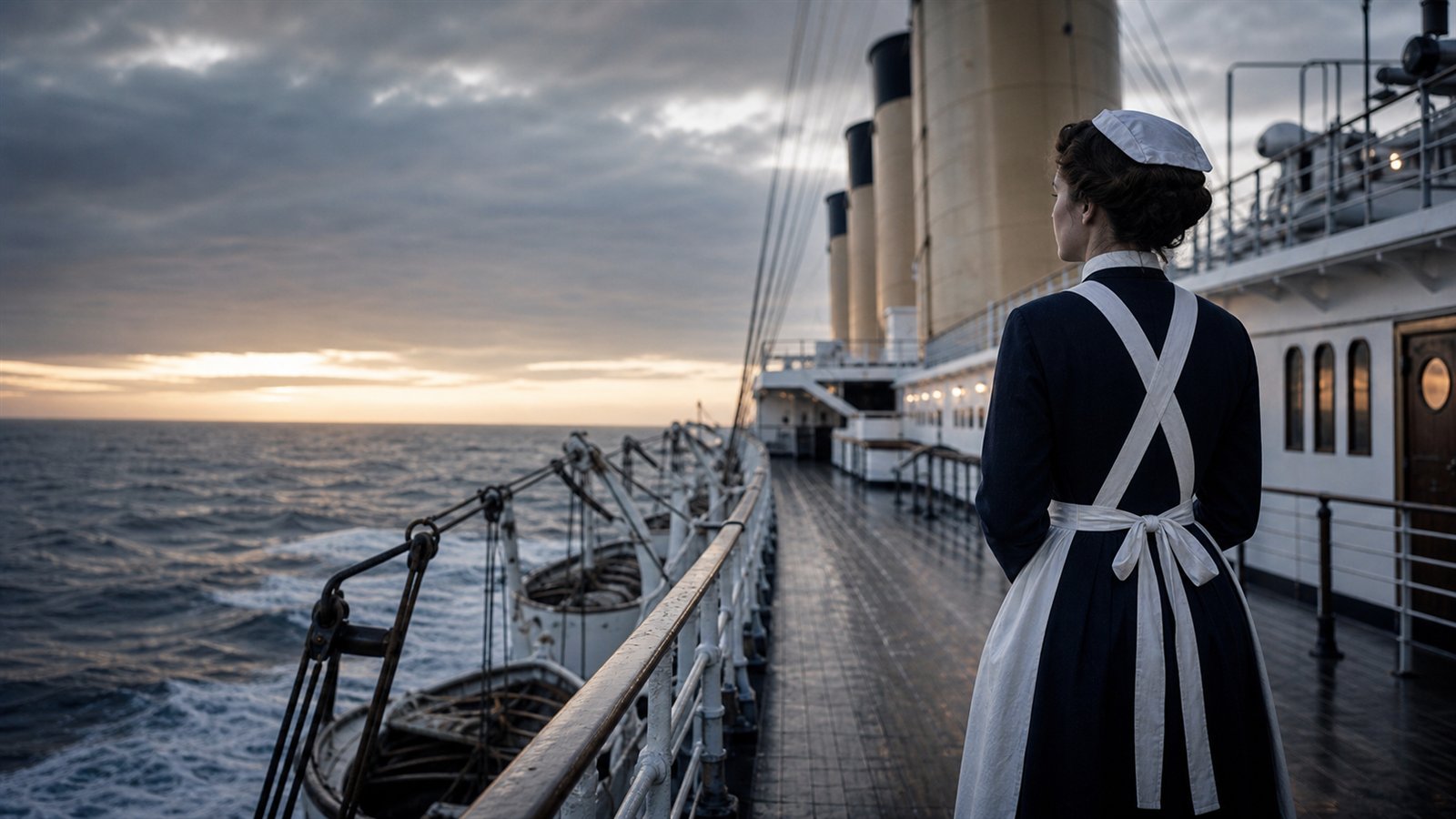
She went aboard to earn a living
Violet Constance Jessop was born in 1887 on the Argentine pampas to a family of Irish immigrants. Her father died while she was still young. The family returned to Britain, where her mother became a stewardess for the Royal Mail Line.
Then her mother’s health deteriorated. Violet left school and looked for a place at sea herself. At 21, she joined the Orinoco. Her wages had to help feed her mother and five younger siblings.
To passengers, the ocean liners promised luxury. To Violet, they meant cabins to clean, meals to serve and working days that could last seventeen hours. At the White Star Line, she earned £2 and ten shillings a month.
She did not go to sea to become a legend. She went because the bills had to be paid.
In 1911, she joined the Olympic. When it entered service, it was the largest liner in the world. A few months later, Violet would discover what a hull that size could do when another ship struck it.
The first collision was called Olympic
On September 20, 1911, the Olympic left Southampton on its fifth Atlantic crossing. Violet was aboard. Near the Isle of Wight, the British cruiser HMS Hawke approached through another channel.
A passenger watched the manoeuvre from the promenade deck. The Hawke first slowed and fell in behind the liner. The danger seemed to have passed. Three to five minutes later, the witness looked again: the cruiser was now accelerating beside the starboard hull, less than 200 metres away.
The two ships displaced an enormous volume of water. The currents tightened between their hulls. The Hawke suddenly swung around and appeared to leap towards the Olympic. Only seconds remained.
Its bow had been reinforced to ram enemy vessels. It hit almost at a right angle near the stern, tearing open the hull above and below the waterline. The impact also bent a propeller shaft.
Violet’s memoirs do not say what she felt at that instant. The records do describe what happened beneath her feet: two watertight compartments began filling and the stern of the world’s largest liner sank lower under the weight of the water.
From the cabins and corridors, nobody could see the wound below the surface. Everything now depended on the bulkheads. If the water rose above them, it would continue through the ship.
The watertight doors held. The Olympic stayed afloat and returned to Southampton without assistance. Nobody died, but the hull was gaping and the ship remained out of service for weeks.
That day, the safety system did exactly what it was designed to do. Seven months later, the same principle would face damage it could not contain.
Violet stayed with the company. Friends soon persuaded her to join a new giant of the same class, advertised as the ship everyone had to experience.
Its name was Titanic.
On Titanic, someone handed her a baby
On the night of April 14–15, 1912, Violet was dozing in her cabin when a jolt woke her. It was nowhere near violent enough to announce what had happened: the liner had struck an iceberg.
She was ordered to put on her life jacket and join the other stewardesses on deck. Around them, many passengers remained calm. Some women even hesitated to enter the lifeboats, particularly when they could not understand orders shouted in English.
The female crew were meant to set an example. If the stewardesses climbed in, perhaps the passengers would follow. Violet therefore took her place in lifeboat 16.
As the boat began to descend, an officer called to her and handed her a baby. She did not know its name, had no idea where its mother was and held it against her cork life jacket to keep it warm.
The lifeboat moved away into the darkness. In her memoirs, Violet recalled spending eight hours on the water before the Carpathia rescued them. She was still numb with cold when a woman rushed towards her, took the child and vanished without a word.
The baby’s identity has never been established with certainty. The victims’ names filled entire lists: more than 1,500 passengers and crew died that night.
Violet returned to land. Then, despite everything she had lived through, she went back to work at sea.
Four years later, the danger came from below
By 1916, Europe was at war. Violet served as a voluntary nurse with the British Red Cross aboard the Britannic, the third Olympic-class liner, now converted into a floating hospital.
At 8:12 a.m. on November 21, an explosion shook the hull near the Greek island of Kea. The ship had struck a mine. Several compartments were open and water was pouring in far too quickly.
Captain Charles Bartlett tried to reach the coast and beach the vessel. The propellers therefore kept turning as the bow sank. Before the general order to abandon ship, two lifeboats were lowered. They drifted into the blades and were smashed apart.
Violet’s boat was being pulled towards the same trap. She saw it closing and jumped. In her memoirs, she described being sucked beneath the hull, struck on the head and then thrown back towards the surface. Years later, a doctor reportedly found evidence of an old skull fracture.
Fifty-five minutes after the explosion, the Britannic disappeared beneath the sea. Of the 1,065 people aboard, 1,035 survived. Thirty died.
In the middle of the evacuation, Violet saved an utterly ordinary object: a toothbrush. After the Titanic, she had remembered how much she missed one. This time, she had decided not to leave it behind.
Violet Jessop is often said to have survived “three shipwrecks.” The Olympic, however, returned to port after its 1911 collision. Violet lived through one major maritime accident, then survived the sinkings of Titanic and Britannic.
After two sinkings, she went aboard again
The nickname “Miss Unsinkable” eventually followed her. It captures the legend well, but not the woman: an employee who kept working behind the scenes on ships where the passengers’ luxury depended on the crew’s calm and endurance.
After the war, Violet returned to regular lines and joined long cruises around the world. Her career at sea lasted forty-two years. She did not retire until 1950.
She then settled in a cottage in Great Ashfield, Suffolk, with her travel memories, her garden and her chickens. She died there in 1971, aged 83.
This is what the archives preserved: a few extraordinary days in an eighty-three-year life. Imagine the rest.

Sources and verification
- The National Archives — Life aboard the Titanic
- Encyclopedia Titanica — Violet Constance Jessop
- Encyclopedia Titanica — Titanic Lifeboat No. 16
- U.S. Naval Institute — Collision between HMS Hawke and RMS Olympic
- Titanic Belfast — The sinking of Britannic
- Royal Museums Greenwich — Papers concerning Violet Jessop
- Violet Jessop — Titanic Survivor, memoir edited by John Maxtone-Graham
Discussion
Have something to add?
A detail, a disagreement or a lead worth pursuing? Tell us. Comments are reviewed before publication.