
He Paid 10,000 Bitcoins for Two Pizzas. And No, It Wasn’t Foolish.
Laszlo only wanted to avoid cooking. He would wait four days, chase strangers online and end up receiving much more than dinner.
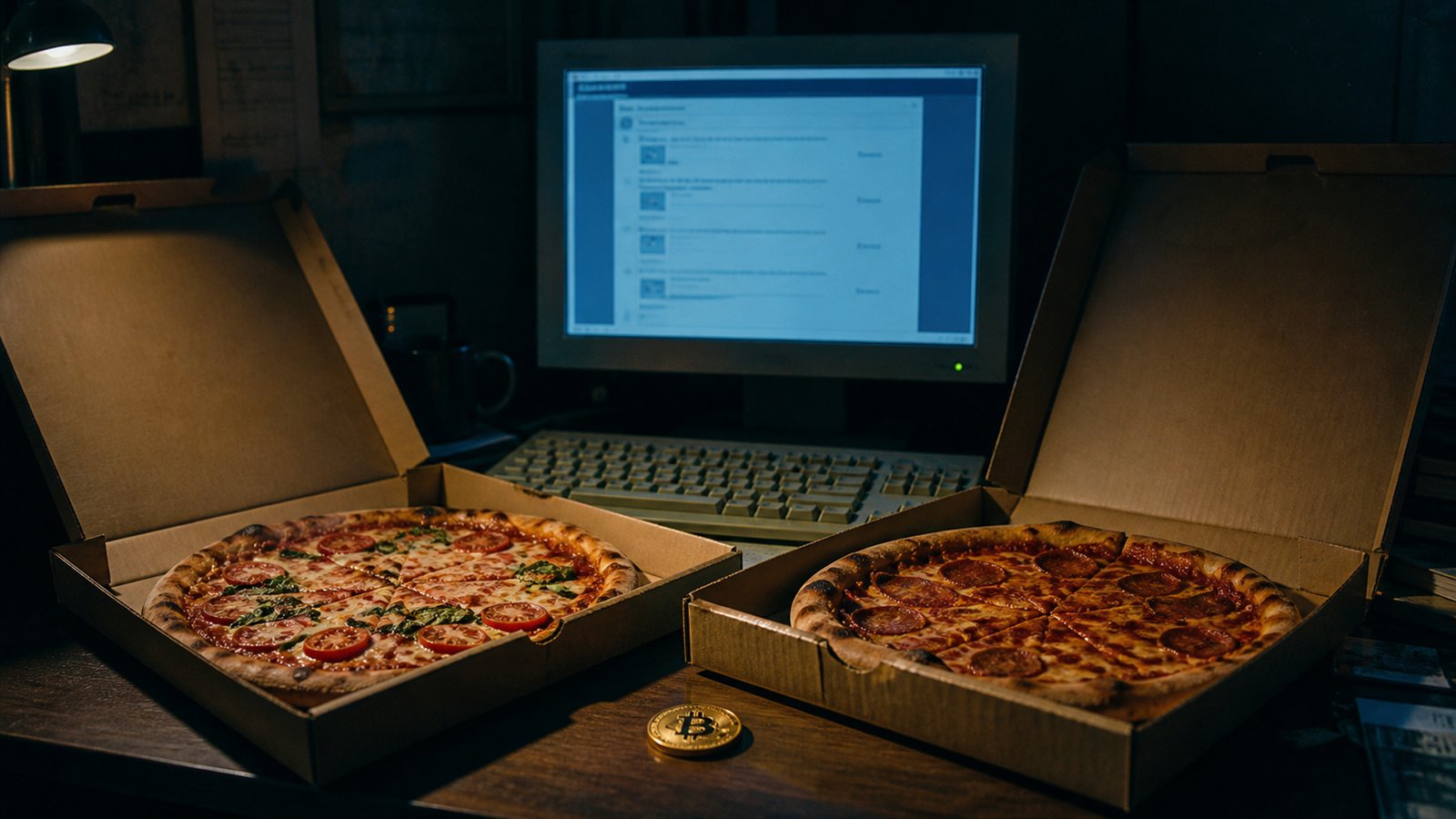
On May 18, 2010, Laszlo Hanyecz posted a small ad on an online forum. He offered 10,000 bitcoins to anyone who would have two large pizzas delivered to him.
He was not asking for anything luxurious. He wanted onions, peppers, sausage, mushrooms, tomatoes or pepperoni. Plain cheese would be fine too. His only real restriction came in a few words: no strange fish toppings.
More than anything, Laszlo wanted leftovers for the next day. Someone could bake the pizzas and bring them over or order them from a distance. It did not matter. He wanted to hand over his bitcoins and watch food arrive at his door without making dinner.
Today, the offer looks like a man setting fire to a fortune. In 2010, it looked more like what it was: a software developer trying to turn numbers on a screen into something he could eat.
For four days, nobody wants his bitcoins
Bitcoin had existed for a little over a year. The network could already send digital units from one computer to another without a bank in between. Technically, it worked. Everyday life was another matter: almost no business knew what to do with those units.
One forum user calculated that the 10,000 bitcoins could be sold for about $41. Two pizzas cost closer to $25 or $30. The offer was generous, but it did not trigger a stampede.
A European user said he was willing to order from Domino’s, only to run into an almost comic problem: how do you pay an American pizzeria from abroad without sounding like a prank caller? Bitcoin could cross borders in seconds. Pizza still required a bank card, an address and someone willing to pick up the phone.
The hours passed. Replies turned into jokes. Three days after the original post, Laszlo returned to ask whether nobody really wanted to buy him food. Perhaps, he wondered, 10,000 bitcoins were not enough.
The sentence sounds unreal today. At the time, it mostly expressed his impatience. Laszlo was not trying to pull off a financial masterstroke. He wanted to be able to say something very simple: I paid for pizza with bitcoins.
Then “jercos” takes the deal
The person behind the username was Jeremy Sturdivant, a young Californian who had followed Bitcoin from its early days. The two men did not really know each other. They had crossed paths in the chat rooms used by the tiny community.
On May 22, Jeremy placed the order remotely. The pizzeria received dollars; it never touched a single bitcoin. Jeremy paid for the boxes and received Laszlo’s 10,000 BTC.
One thoroughly ordinary risk remained: an order placed with a card from another state might be refused, lost or sent to the wrong address. Jeremy later said that was what worried him. Not Bitcoin’s price. Not some future fortune. Just whether the delivery driver would arrive.
Then someone rang Laszlo’s doorbell in Jacksonville. Two boxes were waiting. The photographs show Papa John’s pizzas, although Jeremy later remembered using Domino’s interface. The records never quite settle that small mystery; they confirm what matters.
That evening, Laszlo went back to the forum and announced that the exchange had worked. He thanked “jercos.” Another member replied almost at once: an important milestone had just been reached.
Bitcoin had just left the screen
It was not the first Bitcoin transfer. It was not even a direct payment to a restaurant. It was, however, the first widely documented purchase of a physical product with the currency.
The difference sounds small. It was enormous.
Before the pizzas, Bitcoin proved that a network could move units and preserve a record of the transactions. But a currency that bought no meal, object or service remained an experiment among enthusiasts. To give it value, two people had to agree that those units deserved something in return.
Jeremy accepted the bitcoins because he thought he could use them again. Laszlo spent them because he wanted to know whether they could do more than sit on his computer. Between them, a value appeared. It came neither from a bank nor from a decree. For the moment, it fitted inside two warm cardboard boxes.
Years later, Laszlo would explain that the transaction made Bitcoin real for at least a few people — and certainly for him.
And Laszlo did it again
The story is often told as a single mistake: a man unknowingly trades away a fortune, eats his pizzas and spends the rest of his life regretting it. The forum thread tells a different story.
On June 12, Laszlo said the offer was still open. He would keep paying 10,000 bitcoins for two pizzas as long as he had enough funds. He usually had plenty, and his one-year-old daughter enjoyed the menu too, even if some of the toppings ended up on her face.
So he repeated the transaction. Interviewed by CBS in 2019, he estimated that he had spent around 100,000 bitcoins on various purchases, many of them pizzas.
Jeremy did not hold on to the first payment for years either. By his own account, the 10,000 BTC soon went back into the economy when they were worth about $400. To him, it was not a treasure chest. It was a living currency, meant to circulate.
Laszlo finally suspended his orders in August 2010. He explained that he could no longer produce thousands of bitcoins a day quite so easily. In just a few weeks, the little network had already begun to change.
The fortune did not exist yet
Every May 22, the calculation begins again: multiply 10,000 by Bitcoin’s current price and announce the cost of the “most expensive pizzas in history.” The result keeps changing, but it is always large enough to turn Laszlo into a man who threw away a life of luxury.
That calculation assumes he would have held every unit for years. That he would have sold nothing during the first surges, spent nothing during the crashes and never lost access to his wallet. Above all, it assumes that a future value was already concealed inside the bitcoins, like a banknote waiting to be discovered.
It was not. In the spring of 2010, the project might have grown, stagnated or vanished. The 10,000 bitcoins had a fragile price negotiated by a handful of users on tiny markets. Their future value depended precisely on people curious enough to mine, accept and spend them.
Laszlo never claimed to have foreseen what came next. Nor did he spend the following years cursing his dinner. When asked about the hundreds of millions he might have owned, he simply said that thinking that way would not do him much good.
He had wanted to prove that a bitcoin could buy something. That meant being willing to give some away.
The two pizzas disappeared that night. The world has never stopped recalculating the bill.



Discussion
Have something to add?
A detail, a disagreement or a lead worth pursuing? Tell us. Comments are reviewed before publication.