
He Didn’t Print Counterfeit Notes. He Convinced the Real Printer to Do It.
The paper was right. The ink was right. Even the plates were official. Only the order should never have existed.
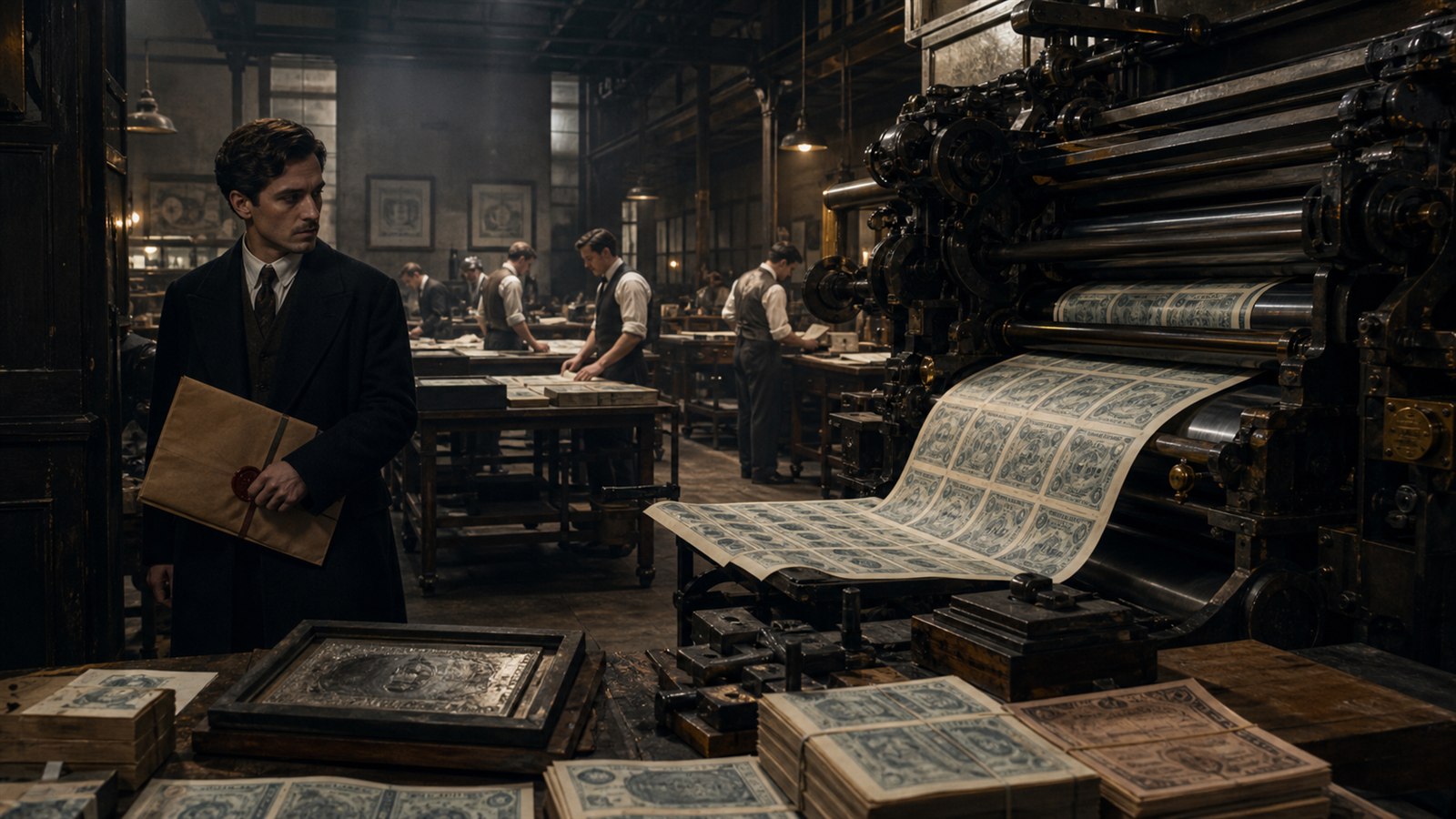
In London, the presses at Waterlow & Sons printed money for governments and central banks. In 1925, the company received an exceptionally confidential order from Portugal.
The printers used the official plates for the 500-escudo note. The portrait of explorer Vasco da Gama appeared on genuine banknote paper. Serial numbers were added, sheets inspected, and sealed bundles left the workshop.
Nobody was making crude notes in a cellar. Nobody was imitating a cashier’s signature by lamplight. Everything came from one of the finest security printers in the world.
The notes were not almost perfect. They were perfect.
The problem was that the Bank of Portugal had never ordered them.
The plan began in a prison cell
Artur Virgílio Alves Reis was not yet thirty. He had already learned that an impressive document could open doors talent alone left closed.
As a young man, he forged an engineering diploma from a British school. The paper took him to Angola, then a Portuguese colony, where it helped him secure public-works responsibilities. He built businesses, bought a railway company and discovered how easily a complicated contract discouraged scrutiny.
His methods finally landed him in prison in 1924 after a financial dispute. According to accounts of the case, that was where he designed an operation on an entirely different scale.
Reis knew something about the Bank of Portugal: certain issues for the colonies could be handled in great secrecy. A confidential order would not necessarily surprise people who saw only one piece of it.
So he did not try to reproduce a banknote. He tried to reproduce the authority allowed to order one.
A fictional contract passed through real offices
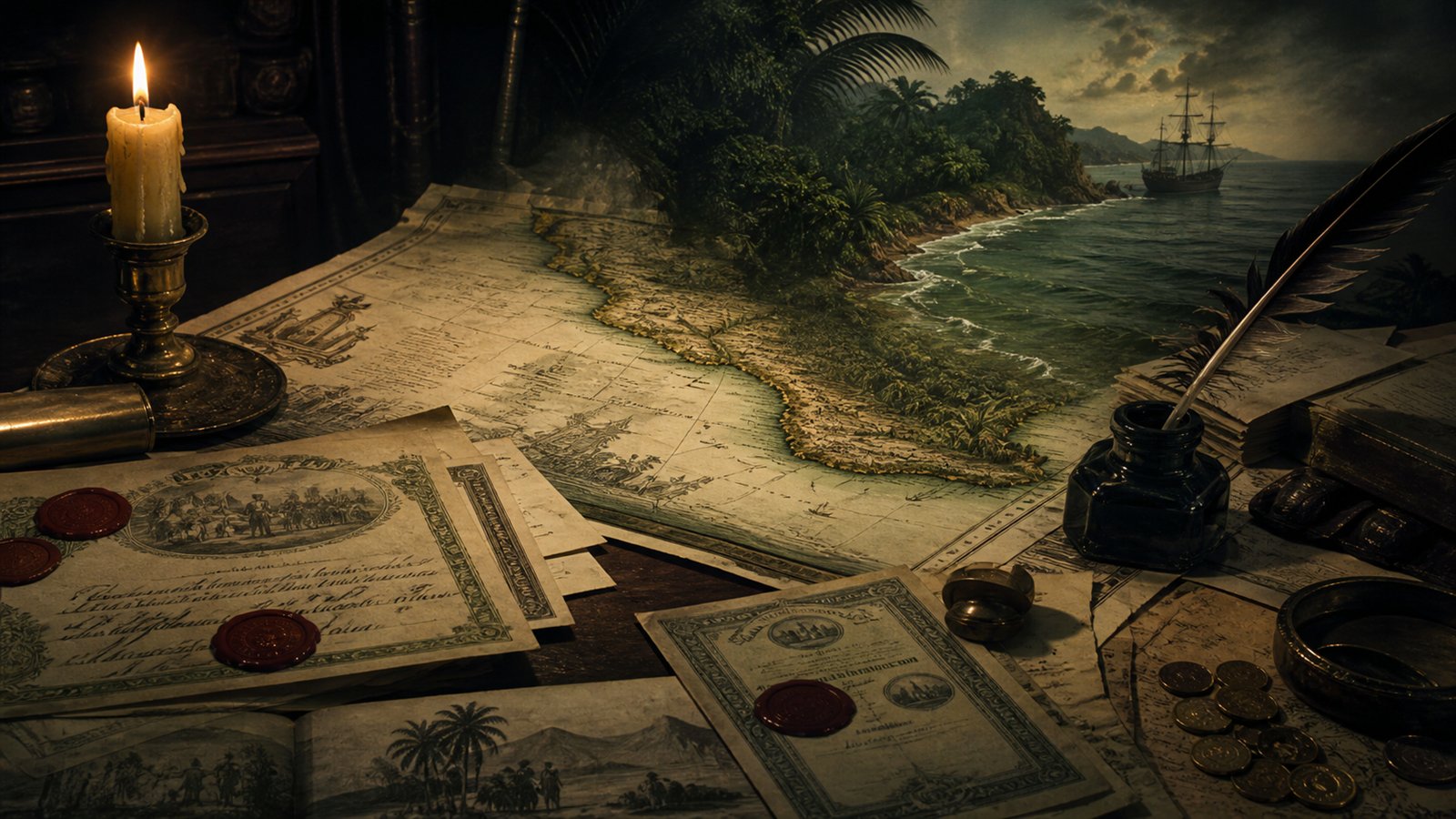
The scheme rested on a forged contract attributed to the Bank of Portugal. It presented the printing of new notes as the secret financing of a loan for Angola.
To make it convincing, Reis accumulated stamps, signatures and certifications. Passages were authenticated before a notary. Consulates and government offices handled copies without seeing the entire project. Each validated a small part; nobody held the whole thing at once.
Reis also recruited partners who could approach the international financial world. The Dutchman Karel Marang van IJsselveere acted as an intermediary with Waterlow & Sons. A German financier, Adolph Hennies, joined the network. José Bandeira, brother of Portugal’s ambassador to the Netherlands, supplied a useful name and access.
The printer asked questions. Why issue notes that might duplicate ones already in circulation? Why all the secrecy?
The answers arrived on headed paper, accompanied by authorisations and assurances supposedly sent from Lisbon. When Waterlow requested further confirmation, the network created it.
The fraud advanced because every check received exactly the document it expected.
Real banknotes reached the wrong hands
Waterlow printed 200,000 notes worth 500 escudos each. Their face value totalled 100 million escudos, an amount estimated at close to one per cent of Portugal’s gross domestic product at the time.
The notes carried serial numbers already used for an earlier issue. That repetition would eventually expose them. But by sight, touch and ordinary inspection, nothing distinguished an official bundle from one ordered by Reis.
The group now had to feed that mass of money into the economy without unleashing a flood of questions. They exchanged some notes in several countries, worked through currency dealers and used bank accounts. Then Reis built the machine meant to absorb the rest.
In June 1925, he founded Banco Angola e Metrópole in Lisbon.
The new bank lent freely. It financed companies, bought assets, offered attractive terms and seemed to possess reserves its rivals envied. In a struggling economy, the institution looked almost miraculously generous.
There was no miracle. Reis was injecting money the real printer had manufactured for him.
The stolen money bought the appearance of success
A financial fraud becomes far harder to break once it stops looking like one.
Reis bought property, jewellery, cars and Lisbon’s Menino de Ouro palace. He invested in businesses and presented himself as a man capable of modernising Angola. His bank employed staff, welcomed customers and produced genuine statements.
His strategy went further. He and his associates began buying shares in the Bank of Portugal itself.
At the time, the central bank was a privately owned listed company. A large enough stake could give Reis influence over its leadership, access to the accounts and perhaps the ability to conceal the anomalies he had created.
The man who had stolen the Bank of Portugal’s authority was now trying to become one of its owners.
Waterlow & Sons had already printed this denomination for the Bank of Portugal. It therefore used the same plates, the same expertise and compliant materials. The notes were counterfeit only because they lacked authorisation. Technically, they came from the right factory.
The same serial number appeared twice
By the autumn of 1925, rumours were gathering around Banco Angola e Metrópole. Its reserves seemed too deep. Its lending attracted suspicion. Competitors and journalists began looking more closely at its operations.
On December 5, the newspaper O Século published its investigation. The previous evening, authorities had inspected bundles and found the one thing that should never meet: two genuine notes carrying the same serial number.
The quality of the paper could no longer save the system. If two perfectly made notes shared the same identity, one belonged to a hidden issue.
The Bank of Portugal ordered the withdrawal of all 500-escudo notes. Queues formed at bank counters. Across the country, holders had to exchange their cash while investigators reconstructed the money’s path.
Reis was arrested on December 6, 1925, as he returned from Angola by ship. He was carrying documents and still seeking support for his projects. His banking empire, built in months, began collapsing before he could even reach home.
The trial had to explain a fraud nobody wanted to believe
The investigation lasted for years. The scale of the case, its international branches and its profusion of paperwork made the story difficult to untangle.
Reis tried to reverse the accusation’s logic. He claimed that he had acted under genuine authorisations or as part of legitimate financing. The contract, he argued in substance, proved the order existed. Yet the contract was the very heart of the forgery.
In June 1930, he was sentenced to twenty years in prison. He served about fifteen before his release in 1945. He died in 1955 after attempting to return to business far more quietly.
Waterlow & Sons, meanwhile, faced the Bank of Portugal in the British courts. The printer was eventually ordered to pay substantial damages. Its reputation never fully recovered, and the company was absorbed a few years later.
The scandal reached far beyond the vaults
The affair erupted in a Portugal already shaken by political instability, inflation and mistrust of the institutions of the First Republic.
The fraud alone does not explain the military coup of May 28, 1926. Historians warn against that shortcut. But the scandal offered a devastating demonstration of weak controls, administrative confusion and the closeness of finance and power.
A handful of men convinced notaries, diplomats, bankers and one of the world’s leading security printers to participate, each at a different level, in an operation that did not exist.
Reis never broke into the central bank’s vault. He manufactured enough proof to make the vault open itself.

Discussion
Have something to add?
A detail, a disagreement or a lead worth pursuing? Tell us. Comments are reviewed before publication.