
She Fell from a Plane Still Strapped to Her Seat. The Jungle Was Only the Beginning.
Seventeen-year-old Juliane Koepcke opened her eyes beneath the canopy. She was injured, alone, and her mother was gone.
When Juliane Koepcke opened her eyes, she could barely see. The forest filtered the daylight above her. Her face was swollen, her collarbone hurt and a deep cut crossed her arm.
She was still strapped to a row of aircraft seats.
No passenger answered nearby. No engine was burning. No piece of fuselage was large enough to explain where she had come from. There were only leaves, insects and the unbroken sound of the Amazon rainforest.
Juliane called for her mother. She waited. Then she called again.
The day before, they had been sitting side by side thousands of metres above Peru.
The Christmas flight entered a storm
On December 24, 1971, Juliane and her mother Maria boarded LANSA Flight 508 in Lima. They were travelling to Pucallpa to spend Christmas with Juliane’s father, Hans-Wilhelm Koepcke.
The Lockheed Electra carried 92 people. At first, nothing about the flight was remarkable. Then the clouds thickened over the Amazon.
The aircraft entered a violent thunderstorm. Turbulence threw luggage through the cabin. Lightning surrounded the plane. Passengers screamed as the wings rolled in the darkness.
Juliane would remember a blinding white light. The aircraft was struck, then broke apart in mid-air.
The cabin vanished around her. Still belted into her seat, the teenager fell towards the forest.
She retained no clear memory of the impact. Specialists have suggested several reasons for her survival: the row of seats may have spun like a leaf and slowed in the air; the canopy and vines may have cushioned the fall; the angle may have spread the force. None makes the scene less vertiginous.
Juliane fell roughly three kilometres. She woke up alive.
She stood up before she understood her injuries
Her first day was partly lost. She fainted again, then came round. One shoe was missing. Her glasses were gone. Her right eye was almost shut and her vision blurred.
Even so, she managed to unfasten the belt and stand. Her collarbone was broken, her knee injured and her body covered with cuts. But her legs held.
She searched for her mother and the other passengers around the place where she had landed. She called until her voice disappeared into the vegetation. No rescue team answered.
Juliane found a few sweets scattered from the plane. They would be almost all she ate over the following days.
She could have stayed beside the seats and hoped to be spotted. But from above, the Amazon looks like a closed roof. An aircraft could pass directly overhead without seeing a scrap of metal.
Then she remembered a rule her father had repeated: in the forest, a small stream joins a larger one. And eventually, people live beside the water.
A trickle of water became her only direction
Juliane had grown up between two worlds. She attended school in Lima, but her parents were German zoologists working in Peru. They had founded the Panguana research station deep in the forest, and Juliane had spent much of her childhood close to the field.
She therefore knew things most of the passengers did not. Noisy animals were not necessarily the most dangerous. Moving water was safer than a stagnant pool. Most importantly, running at random beneath the canopy only meant getting lost faster.
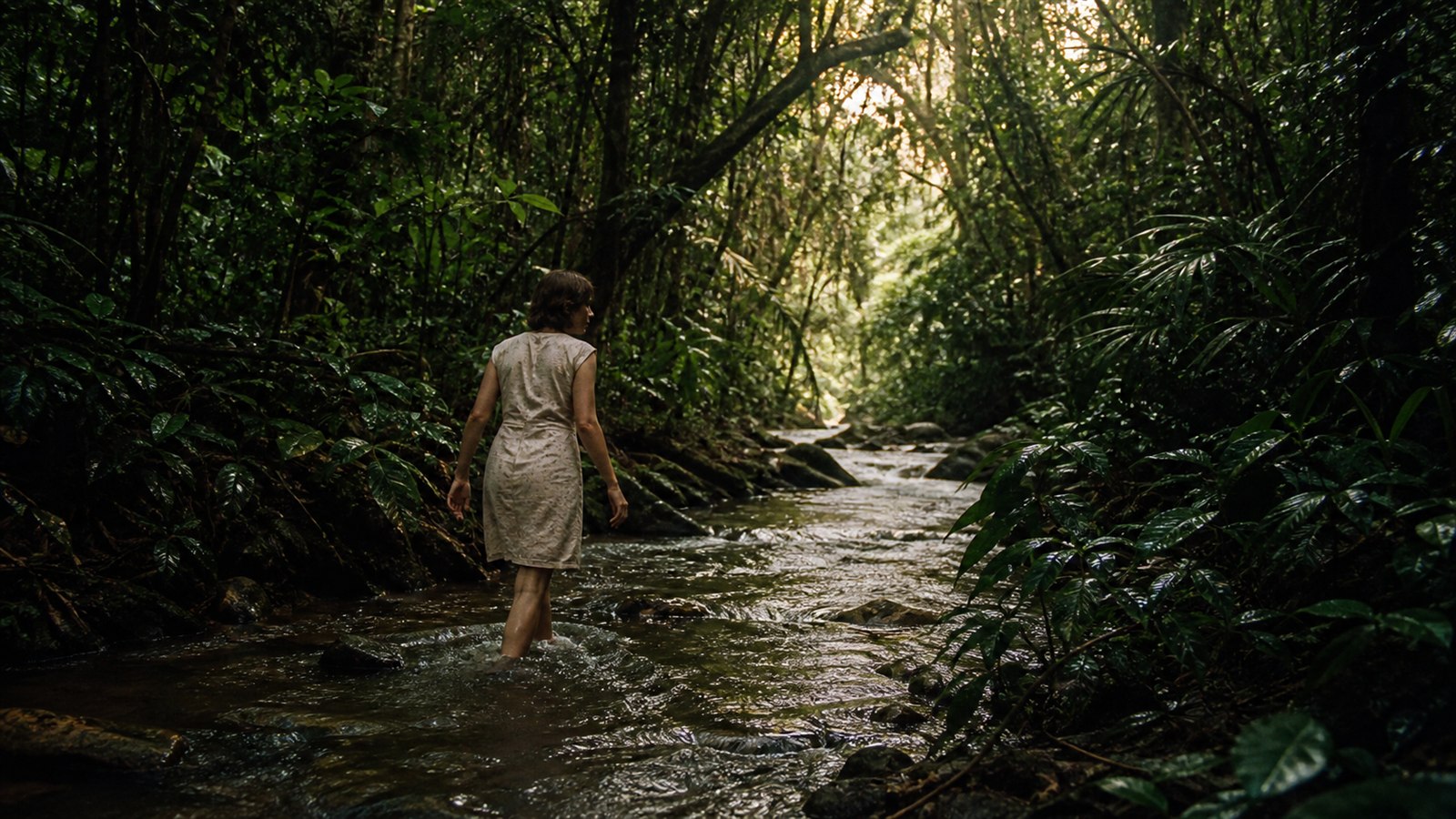
She found a stream and began following it.
When it was too narrow, she walked along the bank. As it widened, she sometimes moved through the water to avoid the dense vegetation. The current chose the route for her.
The nights lasted longest. Rain soaked her clothes. Insects attacked her wounds. She slept on the ground or against a root, then started walking again when the light returned.
Search aircraft passed above the forest. Juliane heard their engines. She shouted and waved, but the canopy did not open.
Rescue was close enough to make a sound. Not close enough to see her.
The forest returned fragments of the aircraft
As she moved on, Juliane found another row of seats buried in the ground. Three passengers were still strapped in.
At first, she could see only their legs. Her mother had painted her toenails before the journey. Juliane went close enough to check. None of the bodies was hers.
The relief did not last. If other passengers had survived the fall, they might be injured somewhere beneath the trees. Juliane kept calling. Nobody answered.
She was now walking without food. Her body weakened, but drinking and following the water kept her from making the most dangerous choice: abandoning the only path likely to lead to another person.
A wound in her arm became infected. Maggots developed beneath the skin. She tried to remove them but could not reach the deepest ones.
Juliane had no machete, map or food supply. She did know how to read a few essential signals: follow water, do not eat an unknown plant, take infected wounds seriously and keep a direction. Her knowledge did not remove the danger; it kept her from making it worse.
Beside the river, she finally found a boat
After more than a week, the stream had become a river. Juliane moved partly through the water, too exhausted to fight every wall of vegetation.
Then she saw a boat.
That simple object meant people came here. A path on the bank led to a small shelter used by forestry workers. Nobody was there, but Juliane found a can containing fuel.
She remembered her father using kerosene to draw maggots from a wound on their dog. She poured the liquid into her arm. The pain was intense. Dozens of larvae rose out and she removed them one by one.
She spent the night in the shelter, convinced that the boat’s owners would return.
The next day, men entered and recoiled when they saw her. Before them stood an injured, emaciated teenager covered in mud, alone in the middle of the forest. Juliane spoke Spanish and managed to explain that she had come from a plane.
They cleaned her wounds, gave her food and took her by canoe to an inhabited settlement. Eleven days after the crash, Juliane Koepcke returned to the world.
Survival did not give her mother back
At the hospital, her account helped search teams locate the wreckage. Juliane described her route, the seats she had seen and the waterways she had followed.
Rescuers eventually recovered Maria Koepcke’s body. Juliane was the only known survivor of the 92 people aboard Flight 508.
The press quickly turned the teenager into a miracle. For years, retellings exaggerated details, invented hand-to-hand battles with snakes or reduced her survival to almost supernatural luck.
Her luck was extraordinary. But after the fall, every day demanded a concrete decision: leave, follow the stream, drink, avoid unknown food, endure the wound and continue when the aircraft flew away without her.
She returned to the forest instead of fleeing it
Juliane Koepcke became a biologist like her parents. She specialised in mammals and returned regularly to Peru. Later, she took over the Panguana research station and worked to protect that part of the Amazon rainforest.
She told her story in a book, then accompanied filmmaker Werner Herzog for the documentary Wings of Hope. Herzog himself had been due to take Flight 508 in 1971, but a booking change kept him off it.
Juliane rejected the story of an invulnerable heroine. She was afraid. She suffered. She made mistakes. In a situation beyond comprehension, she simply had a few pieces of knowledge to hold on to.
At seventeen, Juliane Koepcke followed a stream. It gave her the rest of her life.
Sources and verification
- Juliane Koepcke — “Nightmare in the Jungle,” account published in 1973
- ABC Australia — detailed account of the fall and eleven days in the forest
- UC Davis Magazine — Juliane Koepcke’s life and interview
- VICE — interview with Juliane Koepcke
- Panguana research station — scientific biography of Juliane Diller, née Koepcke
Discussion
Have something to add?
A detail, a disagreement or a lead worth pursuing? Tell us. Comments are reviewed before publication.