
He Took His Captors’ Ship to Free His Family
He knew the forts’ signals, wore the captain’s hat and had to take sixteen people out of Confederate Charleston.
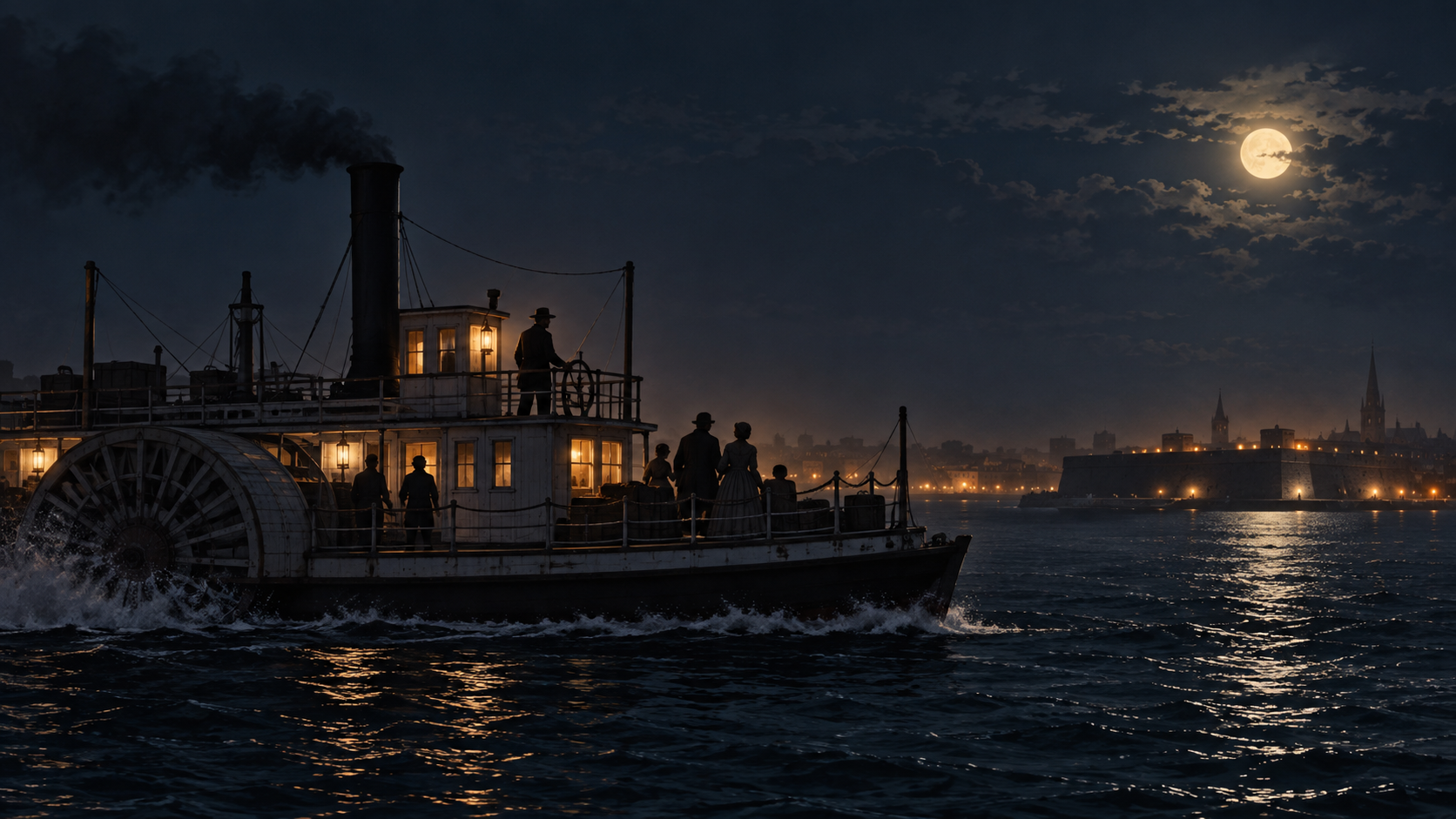
In the middle of the night, a Confederate steamer leaves Charleston harbour. Its white officers have stayed ashore. On board, a pilot named Robert Smalls must first collect families, then pass the guns guarding the exit.
He cannot afford the wrong signal. He cannot afford the wrong silhouette on the deck. And after the last fort is behind him, he still has to convince Union ships that he is not coming to attack them.
The Planter was privately owned but employed by the Confederate army. Robert Smalls served as its pilot. He was also an enslaved man, as were the other Black members of the crew. The steamer knew Charleston’s waters, carried supplies and moved among the harbour’s defences. To the people who normally controlled it, it was an instrument of war. To Smalls and his companions, it suddenly became a way out.
The word “pilot” can create a misleading sense of power. Smalls knew the vessel, the routes, the signals and the forts because his work required it. That skill gave him neither freedom nor ownership of the ship. It simply made one plan imaginable that many others could not have carried out: leaving a military harbour by performing exactly the movements expected of the people held within it.
The plan did not rest on one man alone. The Black crew knew what they risked; their relatives also had to agree to board without knowing whether the next cannon would fire. This was not an improvised escape by a lucky sailor. It was a collective decision built around a window that could close at any moment.
The night the officers went ashore
During the night of 12–13 May 1862, the Planter’s white officers left the vessel. This is not a scene invented afterward: National Park Service accounts describe the opening the crew had been waiting for. Smalls, the Black sailors and the engineers knew they might never get another window as clear as this one.
At around three in the morning, they fired up the boilers. The steamer did not head straight for open water. It first did something no military vessel should do during an escape: it stopped to collect loved ones. Women and children were waiting at the wharves. Smalls’s wife Hannah was among them, with their children.
That choice made the plan slower, more visible, more dangerous. But leaving alone was not the point. The escape had to carry whole families with it, or it meant very little.
Sixteen people, in all, climbed toward a freedom that was still far from certain.
Looking like the ship they were meant to be
The Planter had to leave Charleston by passing Confederate fortifications, including Fort Sumter and Fort Moultrie. A steamer sailing away without permission could draw fire. Smalls knew the required signals because he was a pilot. He knew how the vessel moved, what course it took, where to stand.
He also wore the captain’s straw hat, so that from a distance the figure on deck would not immediately raise an alarm. The detail is often told as theatre. It was really a small answer to an enormous problem: for a few miles of dark water, make it look as though nothing unusual was happening.
The crew gave the expected signals. The Planter moved on. The forts fell behind it.
But the plan did not end beyond the guns. Union ships were blockading the harbour. A Confederate steamer approaching them could be mistaken for an enemy. According to the National Park Service, once the fugitives were beyond the range of the batteries, they raised a white sheet. The vessel was turned over to USS Onward.
The escape had worked. But what had been delivered was more than sixteen people.
Throughout that journey, the crew could not simply flee as quickly as possible. Moving too fast or taking an unusual course could alert the forts; approaching the Union blockade carelessly could invite the very gunfire they were trying to avoid. The escape depended on that paradox: to disappear, the Planter had to remain, for a few more hours, perfectly recognisable.
A ship, guns and information
The Planter arrived with its cargo, artillery pieces and useful intelligence on Charleston’s defences. Smalls knew the waters, routes and Confederate positions. The Union did not simply receive a captured steamer. It received information and people who knew how to use it.
For the passengers, the consequence was more direct: they were no longer someone else’s property. Smalls and the other crew members received a reward for the capture of the ship. He continued serving as a Union pilot, was wounded during the war, then entered public life in South Carolina. He became a state legislator, a member of the US Congress, and one of Reconstruction’s major Black political figures.
That later career can make it easy to miss the real turning point. Before becoming a Union captain or an elected official, Smalls first had to leave a harbour where his body, work and family were legally controlled by others.
A return that was not really a return
Two years after the Planter escape, Robert Smalls bought the McKee house in Beaufort for $605. It was the house where he had been born into slavery. He later lived there with his family.
It would be easy to call that a perfect revenge. It was not: a house could not repair slavery or war, and Smalls did not free himself alone. But it gave a material shape to what the Planter had begun before dawn.
The steamer had passed the forts under a borrowed uniform. Years later, the man who had once left that house owning nothing came home to it.
Leave a Reply