
The Man Who Chose to Enter the Place Everyone Wanted to Flee.
In 1940, Witold Pilecki allowed himself to be arrested so he could infiltrate Auschwitz. He entered to organize, observe and report.
Most stories connected to Auschwitz begin with an impossible question: how do you get out?
This one begins with the opposite.
How do you get in?
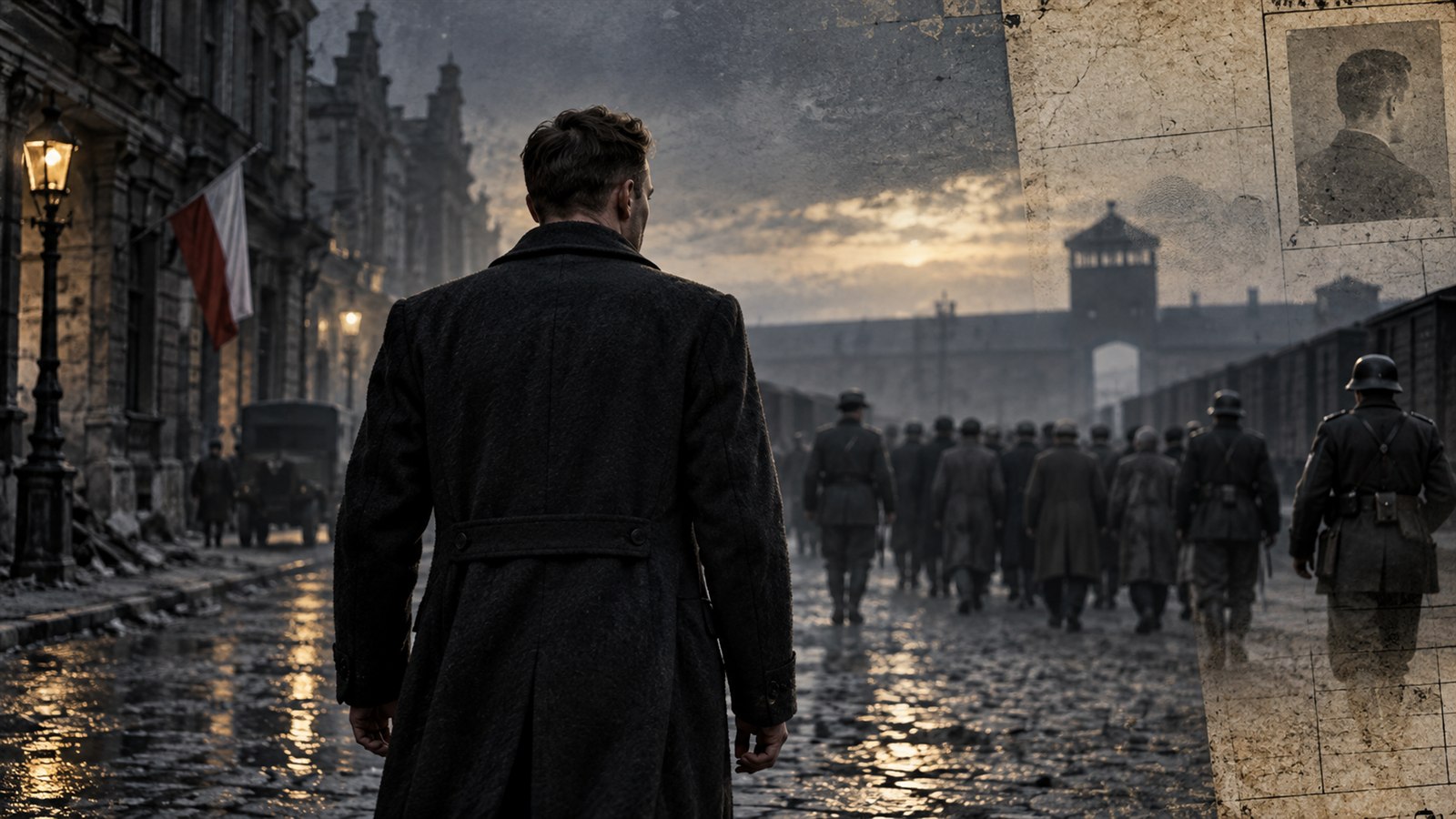
In September 1940, in Warsaw, Witold Pilecki did not try to avoid a roundup. According to historical sources, he allowed himself to be taken so he could be sent to the place almost no one outside yet fully understood: the German camp at Auschwitz.
The act feels unreal because we look at it with everything we know now.
But even in its own time, it remains staggering.
Pilecki was not entering a building to observe for a few hours. He was entering a system designed to break prisoners, sever links, starve, punish and kill. He entered not to die, but to observe, organize and report.
His cover name was Tomasz Serafiński.
His prisoner number would be 4859.
A mission almost beyond human shape
Witold Pilecki was a Polish officer, a resistance member, part of an occupied Poland still trying to understand the German machine. Auschwitz already existed, but its role, its workings and the scale of its crimes were not yet known to the world as they would be later.
The resistance needed information.
Not rumors. Not only secondhand accounts. It needed to know what was happening inside the camp, build a network, get messages out, help prisoners where possible and perhaps prepare future action.
Pilecki’s mission followed a terrible logic: to know, someone had to be inside.
And he agreed to be that person.
During a roundup in Warsaw, he allowed himself to be arrested under a false identity. A few days later, he was transported to Auschwitz.
The most astonishing part of the story is not courage alone.
It is the seriousness with which that courage then had to become organization.
Inside the camp, survival was not enough
At Auschwitz, the first task was simply to endure.
Hunger, violence, disease, forced labor, punishment and arbitrariness attacked bodies and orientation alike. A clandestine network is not born in neutral ground. It has to be built where a denunciation, a search or an accident can cost lives.
Pilecki nevertheless helped organize internal resistance.
The point was not to gather everyone into one large structure that could easily be broken. Groups were compartmentalized. Small cells knew little about one another, so that the capture of one prisoner would not destroy the entire network. Prisoners tried to help others obtain less deadly work where possible. They shared information. They tried to preserve a minimum of action in a place built to strip people of their ability to act.
That detail matters.
A story like Pilecki’s can quickly become a statue: one heroic man, one extraordinary act, a clean legend.
But inside the camp, heroism was not a pose.
It looked like tiny messages, a ration passed along, an identity protected, a piece of information crossing the barbed wire. It looked like the patience of not telling everyone everything, so that something might survive if one person fell.
Getting out what the camp wanted hidden
Pilecki’s mission was not only to survive Auschwitz.
It was to get Auschwitz out of Auschwitz.
The information he gathered had to reach the Polish resistance and then the Allies. It concerned conditions in the camp, violence, organization and the evolution of German terror. The camp was designed to isolate. The network tried to pierce that isolation.
As the months passed, the situation became more dangerous. Members of the organization were killed, transferred or broken by conditions. The risk of exposure increased. Pilecki understood that he had to get out in order to report directly on what he had seen and continue the fight in another way.
He had entered on purpose.
Now he had to escape.
The reverse movement did not erase the first.
It completed it.
The night of the bakery
In the spring of 1943, Pilecki prepared his escape with Edward Ciesielski and Jan Redzej.
The plan led through a work detail assigned to a bakery outside the main camp. It is a concrete, narrow detail, and that is exactly where the story breathes: a vast mission depends on a door, a cable, a moment when surveillance is slightly less tight.
On the night of April 26 to 27, 1943, the three men escaped.
Sources from the Auschwitz Museum describe their departure from the bakery, their movement outside the camp and their flight eastward. They did not vanish magically. They ran, hid, crossed terrain and searched for resistance contacts. After more than two and a half years in the camp, Pilecki finally reached the outside world.
He did not leave in order to be silent.
He reported.
He transmitted.
He wanted to show that Auschwitz was not merely another place of detention, but a reality that had to be faced.
Peace did not save him
Pilecki’s story could end with the escape. That alone would be almost impossible.
But his life continued, and that is what makes it even harder.
He remained active in the Polish resistance, later fought in the Warsaw Uprising, and after the war continued his work in a Poland falling under communist domination. To the new authorities, a man like him was not only a survivor. He was dangerous.
In May 1947, Pilecki was arrested by the Polish communist authorities. He was tried, sentenced to death and executed on May 25, 1948, at Mokotów Prison in Warsaw.
The man who had agreed to enter Auschwitz in order to testify was killed after the war by a regime determined to control what Poland would become and what it would remember.
For decades, his name was pushed out of official communist memory.
It would later return as one of the most powerful symbols of Polish resistance.
A life that resists the easy sentence
There is a temptation, with Witold Pilecki, to reduce everything to the most spectacular sentence: he entered Auschwitz on purpose.
In its essential historical meaning, the sentence is true.
But it is not enough.
Because entering was not the final dramatic act. It was the beginning of slow, dangerous, organized work. It meant accepting that courage does not always look like a frontal attack. Sometimes it means disappearing under a false name, becoming a number, surviving long enough for information to get out.
Pilecki does not make Auschwitz less terrible because he acted there.
He only makes it impossible to say that no one tried to know.
His story rests on an almost unbearable paradox. He chose imprisonment in order to create a passage. He took a number in order to preserve names. He entered a place designed to make human beings disappear so that the place itself would not disappear from the evidence.
We often remember those who escape.
Witold Pilecki forces us to remember the man who first agreed to enter.



Leave a Reply