
The War Had Been Over for 29 Years. He Was Still Waiting for Orders to Surrender.
Leaflets, newspapers and the voices of his family fell into the jungle. Hiroo Onoda examined them, then went back into hiding.
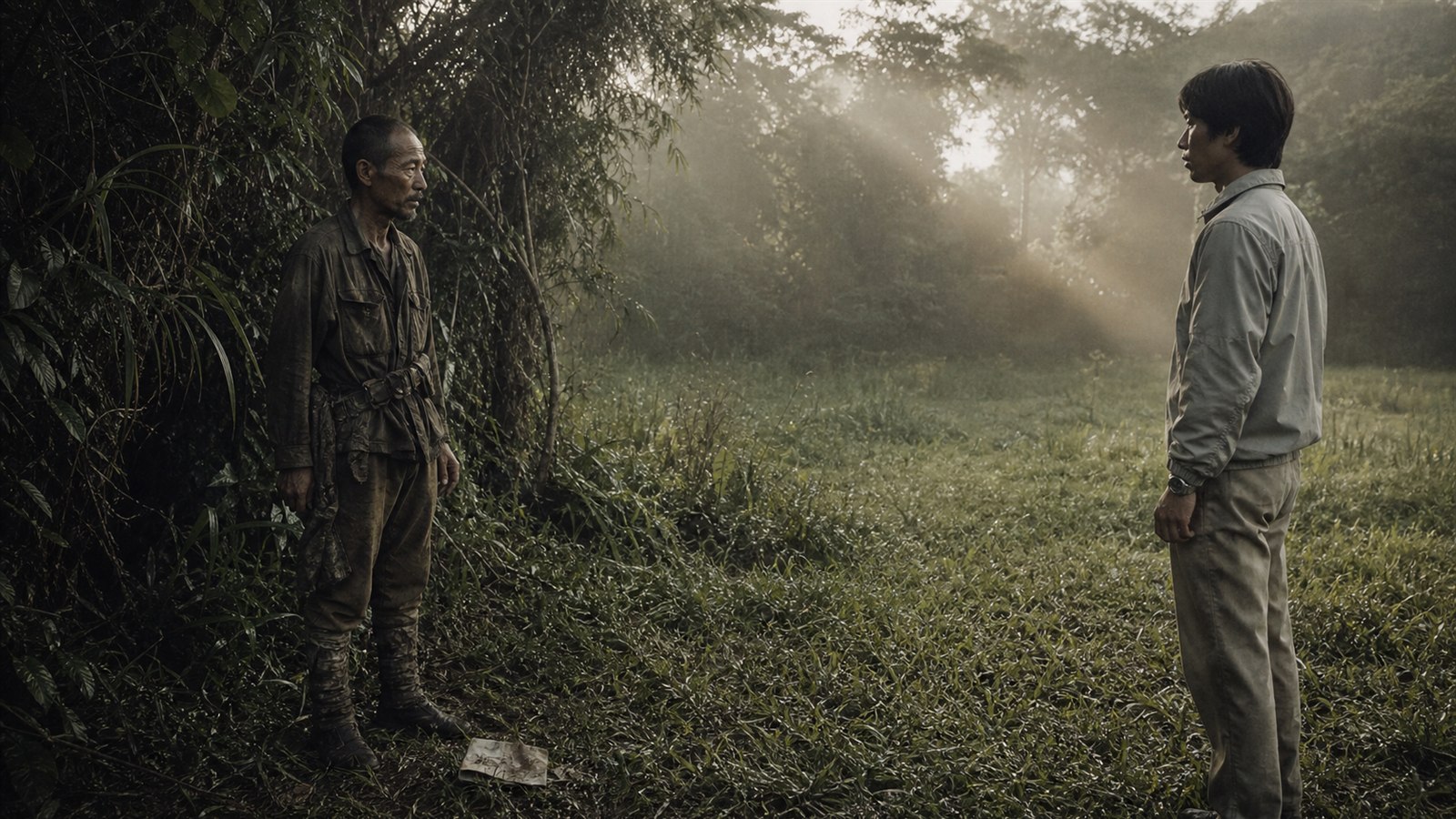
In February 1974, Norio Suzuki made camp on the Philippine island of Lubang. The 24-year-old Japanese traveller described his quest almost as a joke: find Hiroo Onoda, a panda and the Abominable Snowman, in that order.
The first was supposed to be living somewhere in the surrounding jungle. Onoda was a former lieutenant in the Imperial Japanese Army. Japan had surrendered in 1945, but rumours, tracks and gunfire suggested he had never left his post.
On February 20, Suzuki spotted a thin man in a patched uniform. The soldier still carried his rifle and watched the stranger camping alone with suspicion honed over almost thirty years.
Suzuki told him about Japan. He explained that the war was over. Onoda did not shoot. He listened, asked questions and eventually agreed to be photographed.
But he refused to return.
He would abandon his post only if a superior officer came to order him to do so.
In 1944, a young officer received a mission with no end date
Hiroo Onoda was 22 when he was sent to Lubang in December 1944. The island lies south-west of Manila, along a sea route into the bay. American forces were returning to the Philippines and the Japanese Empire was retreating.
Trained in intelligence and guerrilla warfare, Onoda was to slow the enemy, sabotage facilities and maintain resistance in the island’s interior. The orders he remembered were absolute: do not surrender, do not take your own life, and wait for the Japanese Army to return, even if it took years.
The fighting ended quickly. American troops landed in February 1945. Much of the Japanese garrison was killed or captured. Fifty-five soldiers still refused to surrender after Japan capitulated in August; by spring 1946, almost all had laid down their weapons or died.
Onoda remained with three men: Yūichi Akatsu, Shōichi Shimada and Kinshichi Kozuka.
They survived on coconuts, bananas, stolen cattle and rice taken from residents. They maintained their weapons, shifted their hiding places and interpreted every search party as an enemy operation. On their calendar, the war had not stopped. It had only changed form.
The sky sent them peace. They saw a trap
Aircraft dropped leaflets announcing Japan’s surrender. The four men read them. Some contained precise instructions. Others reproduced messages from Japanese officials.
Yet they examined them as forgeries. Psychological warfare existed, the Americans wanted to draw them out, and the group could always find an awkward word or a conveniently phrased sentence that confirmed their suspicions.
In 1950, after months of tension, Akatsu left the others and eventually surrendered. He told the authorities that three soldiers remained in the jungle. Family letters were then dropped. Teams crossed the island with loudspeakers.
Onoda heard familiar voices. He convinced himself that they had been recorded under duress or imitated. When a message resisted that theory, another explanation replaced it: perhaps Japan was still fighting elsewhere; perhaps the political situation had changed; perhaps his family was participating in a secret operation.
Every piece of evidence for peace became evidence of the enemy’s sophistication.
The years took the men one by one
In May 1954, a Philippine patrol surprised the group. Shimada was killed. Onoda and Kozuka disappeared into the vegetation again.
They did not live in a forgotten hut where time stood still. They kept moving, repaired their clothes with whatever they found, watched the roads and descended towards farmland to take food. They saw modern aircraft and found radios or newspapers.
The news did not necessarily break their belief. It became part of it. Japan’s prosperity might be propaganda. The Korean War might be a continuation of the global conflict. The 1964 Tokyo Olympics might be a diversion.
In 1959, after an extensive search found nothing, the Japanese government declared them dead. The residents of Lubang knew the jungle was not empty.
On October 19, 1972, Onoda and Kozuka burned piles of freshly harvested rice in what they considered an act of sabotage. Philippine police arrived. Kozuka was shot dead. Onoda vanished once more.
For the first time in eighteen years, he was alone.
Popular retellings often depict Onoda as an isolated man fighting only vegetation and time. Lubang was inhabited. The soldiers who remained after the war stole crops and cattle, burned stores and fought residents or law enforcement. Civilians were killed. To the local population, their survival was not a distant adventure but a concrete threat.
A stranger succeeded where armies and families had failed
Kozuka’s death convinced Japan that Onoda was probably alive. A new search began. Philippine president Ferdinand Marcos ordered that he be captured without being killed despite local anger. For months, soldiers, relatives and officials failed to find him.
Then Norio Suzuki arrived without a uniform, a loudspeaker or much of a plan.
Perhaps the meeting worked precisely because it did not resemble an operation. Suzuki camped alone. He made no attempt to disarm Onoda and accepted the logic in which the soldier still lived.
Onoda told him there was one condition for leaving. His former commander had to relieve him of his mission officially.
Suzuki returned to Japan with photographs. The authorities found Yoshimi Taniguchi, the former major who had become a bookseller. He was given a uniform and taken to Lubang.
On the evening of March 9, 1974, Onoda reported to him in a camp deep on the island. Taniguchi read the order ending operations and releasing his former subordinate from every military duty.
Onoda listened. This time, no forgery, spy or theory could hold the war in place.
He came down from the mountain with a rifle that still worked
On March 10, Philippine officers escorted Onoda from the jungle. He wore his worn uniform and carried his sword, Arisaka rifle, ammunition and grenades. His weapon had been maintained for almost three decades.
The next day, he symbolically handed his sword to President Marcos. The Philippines granted him a full pardon for offences committed during and after the war.
In Japan, about 7,000 people waited at the airport. Television channels interrupted their programmes. Onoda became the faithful soldier, the survivor who had remained at his post while the country transformed into an economic power.
Lubang felt differently. Residents were relieved he was gone. Affected families saw a man pardoned and celebrated abroad while their dead and losses remained at the edge of the story.
That contrast takes nothing from Onoda’s physical endurance or the mental hold of his orders. It simply prevents thirty years of violence becoming a beautiful tale of loyalty without victims.
He returned to a country that was no longer the one he had left
The Japan of 1974 had no imperial army, no emperor presented as a god and no longer the same relationship with authority. Onoda was welcomed as a symbol, but said he felt uncomfortable in its consumer society.
He went to raise cattle in Brazil, returned regularly to Japan and founded outdoor education camps for young people. He published memoirs, lectured and lived to the age of 91.
Despite a line repeated often, he was not the last Japanese soldier to emerge from hiding. Teruo Nakamura was discovered in Indonesia in December 1974. Onoda remains the most famous because his return gathered everything a country could project onto one man: loyalty, the absurdity of obedience, the shame of defeat and the desire for an unbroken hero.
For Japan, Onoda’s war ended in 1974. For Lubang, it had simply taken twenty-nine years to leave the forest.

Sources and verification
- US National Archives — diplomatic cables and chronology of Hiroo Onoda’s return
- Hiroshima Peace Institute — Philippines Perspectives Regarding Japanese Army Stragglers
- Hiroshima Peace Institute — Japanese army stragglers and the media
- Hiroo Onoda — No Surrender: My Thirty-Year War, Philippine eLib record
Discussion
Have something to add?
A detail, a disagreement or a lead worth pursuing? Tell us. Comments are reviewed before publication.