
The Trolleybus Vanished Underwater. He Kept Diving Until His Lungs Gave Out.
Shavarsh Karapetyan had just finished training when the vehicle left the road. Ten metres underwater, its windows would not open.
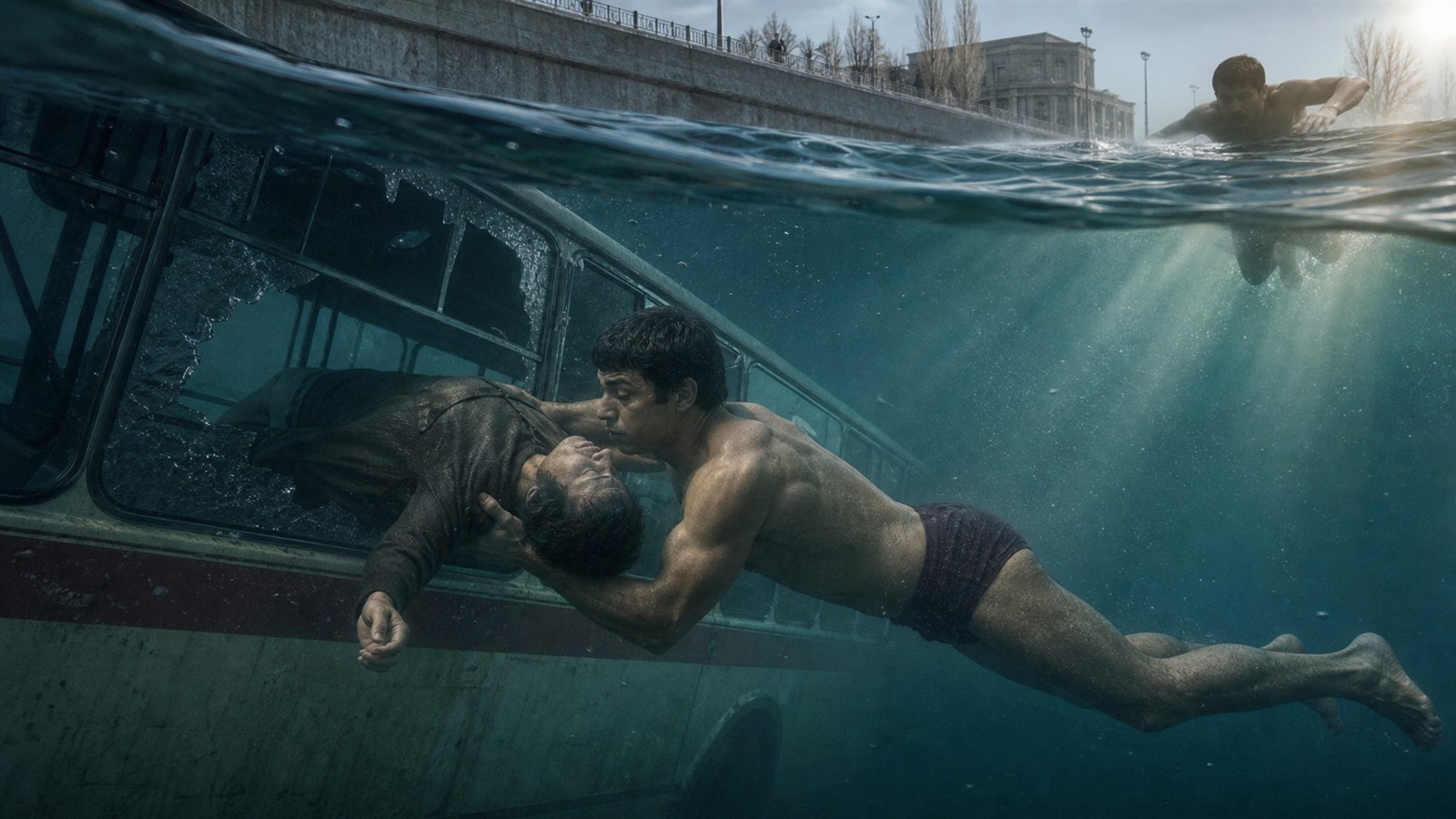
Shavarsh Karapetyan heard the noise before he saw the vehicle. A crash on the road, then a trolleybus crossed the edge of the dam and plunged into Lake Yerevan. The water closed over its roof.
Shavarsh was twenty-three. He was training on the reservoir’s shore with his brother Kamo and his coach. That morning, September 16, 1976, they had put their bodies through a long running session. Seconds earlier, exhaustion had been the purpose of the exercise.
Now it was their first handicap.
The trolleybus came to rest about twenty-five metres from shore, beneath nearly ten metres of water. Inside, dozens of passengers were trapped in darkness. Pressure jammed the exits. The impact stirred up silt from the bottom and turned the water into a mass in which almost nothing could be seen.
Shavarsh stripped off what would slow him and entered the lake. He was a champion finswimmer. But he had no air tank, mask or fins, and no competition had taught him how to open a submerged vehicle full of terrified people.
He Had Trained His Body to Win Seconds, Not to Give Them Away
Shavarsh Karapetyan was already one of the Soviet Union’s finest finswimmers. The discipline is raced at high speed, on the surface or underwater, using fins and, depending on the event, a snorkel or breathing equipment.
Published accounts disagree over the exact tally of his records and titles, but all describe a multiple champion who held numerous world records and European crowns. His training rested on an ability that was about to become vital: sustaining effort when the brain demanded air.
On September 16, sporting performance no longer mattered. He had to descend to the trolleybus, find an opening, enter the cabin, seize someone, get back out, rise to the surface and begin again.
One dive would already have been dangerous. At ten metres, every round trip consumed time the passengers no longer had. Shavarsh also knew that he would barely be able to see them. He would have to search with his hands.
Kamo joined him in the water and received the people he brought up. On the bank, their coach and other witnesses began trying to revive the bodies. The rescue became a human chain whose first link vanished beneath the surface on every journey.
The Window Would Not Open, So He Struck It Until He Could Enter
Accounts differ about the exact tool and how the rear window gave way. They agree on the essential act: Shavarsh broke a trolleybus window underwater. The glass cut his legs but finally created a passage.
Inside, the darkness was almost complete. Silt, seats and bodies slowed every movement. He could not select the closest person by sight. He reached out, found clothing or a limb, gripped whatever he could and turned back towards the light.
The ascent compressed his chest. At the surface he handed over the passenger, dragged in air and returned to the same black rectangle. Every descent added a little more cold, a little more blood to the water and a little less strength in his legs.
The most frequently cited figures describe forty-six dives or attempts, dozens of people extracted and about twenty survivors. The available records do not all count in the same way the bodies recovered, people resuscitated and those who ultimately survived in hospital.
One thing does not vary: he kept going underwater long after any reasonable person would have understood that he might remain there.
Once, He Brought Up a Seat Instead of a Passenger
In the sightless cabin, Shavarsh’s hand found a shape. He gripped it, drove with his legs and dragged it out of the vehicle. Only when he reached the surface did he discover that he had recovered a seat.
The detail haunted him. An entire dive, a reserve of breath, a return journey that might have belonged to someone. He later said that the seat still appeared in his dreams.
He dived again. By then, the rescue no longer resembled a clean sequence of athletic movements. Muscles stiffened, cuts burned and oxygen deprivation eroded precision. The boundary between retrieving someone and becoming the next person who needed to be pulled out moved closer on every descent.
Emergency crews arrived, boats took position and others joined the operation. Shavarsh continued until his body could no longer sustain the rhythm.
The episode lasted about twenty minutes according to several detailed accounts. On a track, twenty minutes can be divided into laps and split times. In the lake, they were made of descents towards a vehicle where every second took something from the passengers and from the man trying to reach them.
The Lake Did Not Immediately Give Him Back the Life He Had Before
When Shavarsh finally left the water, he had numerous cuts. The lake was heavily polluted. His open wounds exposed him to severe infection, while the cold and repeated dives had badly damaged his lungs.
He remained in hospital for weeks. Several accounts mention forty-five days and serious pulmonary complications. A career that had seemed destined for more titles never resumed exactly where it had stopped at the water’s edge.
He attempted a return to competition and still managed another high-level performance. But breathing had become harder. The body capable of breaking records had paid for every ascent.
In the Soviet Union of 1976, the story was not immediately told with the prominence it later acquired. Some of the survivors did not even know who had pulled them from the cabin. Public recognition arrived gradually, through articles, honours and retellings.
For Shavarsh, however, the result could not be reduced to medals received afterwards or a number printed in newspapers. He knew above all the difference between the people brought out and those his body had no time left to reach.
Nine Years Later, He Ran Towards the Smoke Again
In February 1985, a fire broke out at Yerevan’s sports and concert complex. Shavarsh was nearby. He joined the rescue effort and entered the smoke-filled building before being injured and taken to hospital.
The second episode is often appended to the first as though courage were a collection of disasters. More importantly, it shows that the lake had not produced one isolated act under the force of adrenaline. Faced with collective danger, Shavarsh again moved towards the place everyone else was trying to leave.
He never presented himself as invulnerable. His accounts emphasise work, training and the instant in which a person must act. Courage erases neither fear, damage nor the faces of those one could not save.
Decades later, the Aurora foundation described him as the embodiment of an “ordinary hero.” The phrase seems almost too small for the trolleybus, but it contains a truth: that morning, nothing formally required him to enter the water.
The Records Still Dispute the Figures. Twenty People Went On Living
The number of passengers, dives and people extracted varies slightly from one account to another. The disaster unfolded quickly in opaque water, with several rescue groups and victims transported to hospitals. Pretending that every second was neatly counted would impose an order the scene never possessed.
The firmest and most frequently repeated figure is roughly twenty survivors directly linked to Shavarsh’s recoveries. Twenty lives that continued after what should have been an ordinary trolleybus journey.
He had spent years winning fractions of a second from other swimmers. In Lake Yerevan, those seconds changed ownership.
His greatest record appears on no stopwatch. It is measured in the years other people lived after he had almost no breath left to give them.

Sources and fact-checking
- 168 Hours — The Trolley-bus and Shavarsh Karapetyan
- Mediamax — interview and biography of Shavarsh Karapetyan
- Armenian Museum of Moscow — account of the rescue and biographical details
- Aurora Humanitarian Initiative — tribute to Shavarsh Karapetyan
- Grantland — The Plunge, a long-form investigation into the rescue and its records
Discussion
Have something to add?
A detail, a disagreement or a lead worth pursuing? Tell us. Comments are reviewed before publication.