
The Genius Fund That Kept Winning Until Wall Street Trembled.
LTCM looked like finance at its smartest. Then one highly leveraged idea started to threaten Wall Street itself.
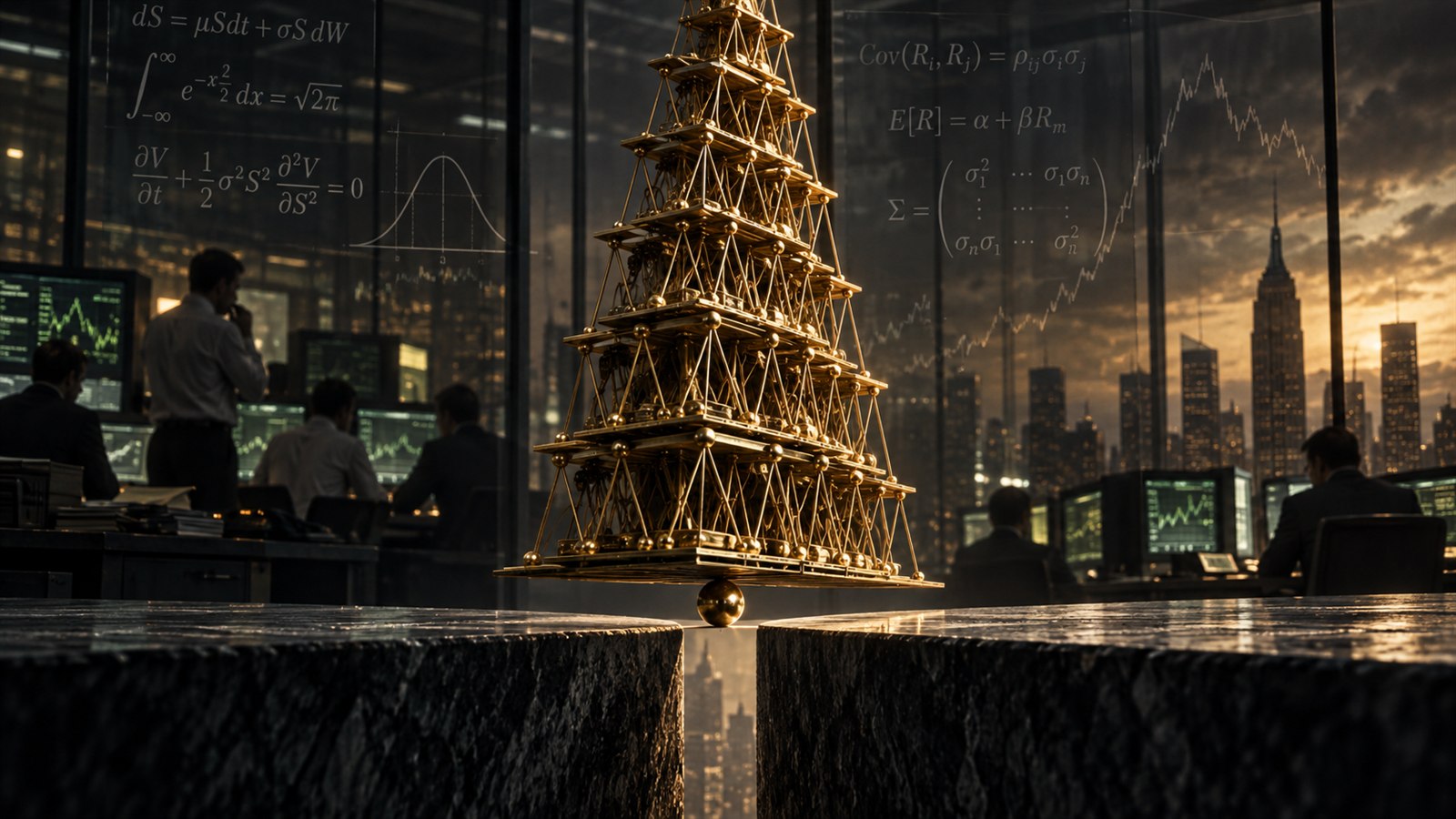
There were no crowds outside a bank branch.
No customers banging on glass doors. No open vault, no missing cash, no employee running away with a suitcase. At first glance, nothing about the crisis looked especially cinematic.
And yet, in September 1998, some of the biggest names on Wall Street gathered around a problem that frightened them deeply: a private fund, almost unknown to the general public, was close to collapse. If it fell in the wrong way, it could force everyone to sell at once.
The fund was called Long-Term Capital Management.
LTCM, for people who prefer clean initials.
It had not been built like a carnival scam. In fact, it was almost too serious to look dangerous. It had veterans from major financial firms, mathematical models, celebrated academics and two future Nobel Prize winners attached to its intellectual aura.
It was a machine designed by very smart people to make money from tiny differences.
The problem was that it did so at enormous scale.
Picking up pennies with a crane
LTCM’s basic idea can sound almost reasonable when explained slowly.
In financial markets, two very similar assets can sometimes trade at slightly different prices. One bond resembles another. One instrument looks a little too expensive or too cheap compared with a close cousin. LTCM would bet on the return to normal: the gap would close.
This was not the crude casino image of putting everything on red. It was a convergence trade. The fund believed it could spot small anomalies and wait for them to correct.
But small anomalies do not pay much.
To produce spectacular returns, the fund had to do this again and again. And to do it at that scale, LTCM borrowed. Heavily. It multiplied positions, entered derivatives contracts and spread exposure across several markets. By the end of 1997, according to Federal Reserve History, it held about 30 dollars of debt for every dollar of capital.
On a spreadsheet, that can still look elegant.
In the real world, it means even a limited adverse move can become enormous.
The results made everyone less careful
For several years, the machine seemed to work.
The fund was founded in 1994 by John Meriwether, a former Salomon Brothers executive. The names around it were impressive. Robert C. Merton and Myron Scholes would receive the Nobel Prize in economics in 1997. Investors liked the rare mixture of academic prestige, market experience and the promise of profits regardless of the broad direction of prices.
The returns strengthened the legend. Federal Reserve History cites 20 percent in 1994, 43 percent in 1995, 41 percent in 1996 and 17 percent in 1997.
When a strategy wins that much, it stops looking like a hypothesis.
It starts looking like proof.
Banks lent. Counterparties traded. Investors stayed. Each participant could see a piece of the fund, one position, one isolated risk. What was harder to see clearly was the entire creature created by all the positions together.
That is where finance can become dangerous without looking reckless.
The calculations can be sophisticated. The people can be brilliant. The documents can be immaculate. And still the system can rest on a sentence that is far too fragile: normally, the gaps close.
Then the world stopped being normal
In 1997, the Asian financial crisis had already shaken markets. In August 1998, Russia devalued its currency and stopped payments on parts of its debt. Investors rushed toward what they saw as safest, most liquid and easiest to sell.
LTCM expected certain spreads to converge.
They diverged.
Not once. Not in one small corner of the portfolio. In almost every place where the fund needed logic to return quickly, panic pushed prices the other way. Liquid assets became even more sought after. Less liquid assets fell. The gaps the fund had treated as temporary widened further.
Each passing day made the problem heavier.
A lightly indebted fund can wait. A highly leveraged fund must answer margin calls, reassure lenders and sometimes sell things it would rather keep. Time becomes a luxury. The theory may be right in the long run; the balance sheet can die before that.
In August 1998, LTCM lost 44 percent of its value.
The number was not merely embarrassing.
It was threatening.
The danger was no longer only LTCM
If LTCM had only lost its investors’ money, the story would have been harsh but contained. Wealthy people took a risk and were wrong.
But the fund was not isolated.
It had positions with many major institutions. It held assets that would have to be sold if everything collapsed. It was tied, through contracts and counterparties, to firms that did not want to discover the real value of their collateral at the same time.
The fear was not that LTCM was too prestigious to fail.
The fear was that it was too entangled.
If everyone tried to get out before everyone else, prices could fall violently. Forced liquidation could create losses elsewhere, then more selling, then more margin calls. The disaster might not be one giant hole. It could be a chain of rushed sales, each rational on its own, but dangerous together.
On September 23, 1998, a private solution was arranged. Fourteen banks and brokerage firms injected about $3.625 billion. The New York Fed helped coordinate the process, but did not put its own money into the rescue.
LTCM avoided a disorderly collapse.
Its positions were gradually unwound.
The myth never fully recovered.
The geniuses had not forgotten how to count
It would be easy to turn the whole episode into a simple story about mathematical arrogance. Nobel Prize minds believed they could master the market, and the market humiliated them.
That is not entirely wrong, but it is too easy.
The LTCM trap is more interesting. The fund was not merely betting on direction. It was betting on the return of normal order. In many situations, that kind of trade can make sense. Similar prices often move back together. Panics calm down. Anomalies disappear.
But “often” is not “always.”
And more importantly, “eventually” is not “in time.”
LTCM showed that an intelligent idea can become foolish when it is too large to survive its own delay. The fund may have been right about some spreads in the long run. But it had borrowed so much money that the market did not need to contradict it forever.
It only had to contradict it hard enough, for long enough.
The tiny difference worth billions
The LTCM episode became a modern financial fable. People talk about models, leverage, derivatives and systemic risk. All of those words are correct. But they can hide the simplest scene.
At the beginning, there is a small price difference that very smart people consider abnormal.
Then there is borrowed money used to turn that small difference into a large profit.
Then the world shakes, and the small difference grows.
And grows.
And becomes too large to wait out.
LTCM did not prove that mathematics is useless. It proved something more uncomfortable: even a good idea can become dangerous if it absolutely has to be right by Friday.



Leave a Reply