
Account 88888 Was Meant to Hide Small Errors. It Swallowed a 233-Year-Old Bank.
In Singapore, Nick Leeson reported almost risk-free profits. In London, no one looked closely enough at the hundreds of millions being sent to him.
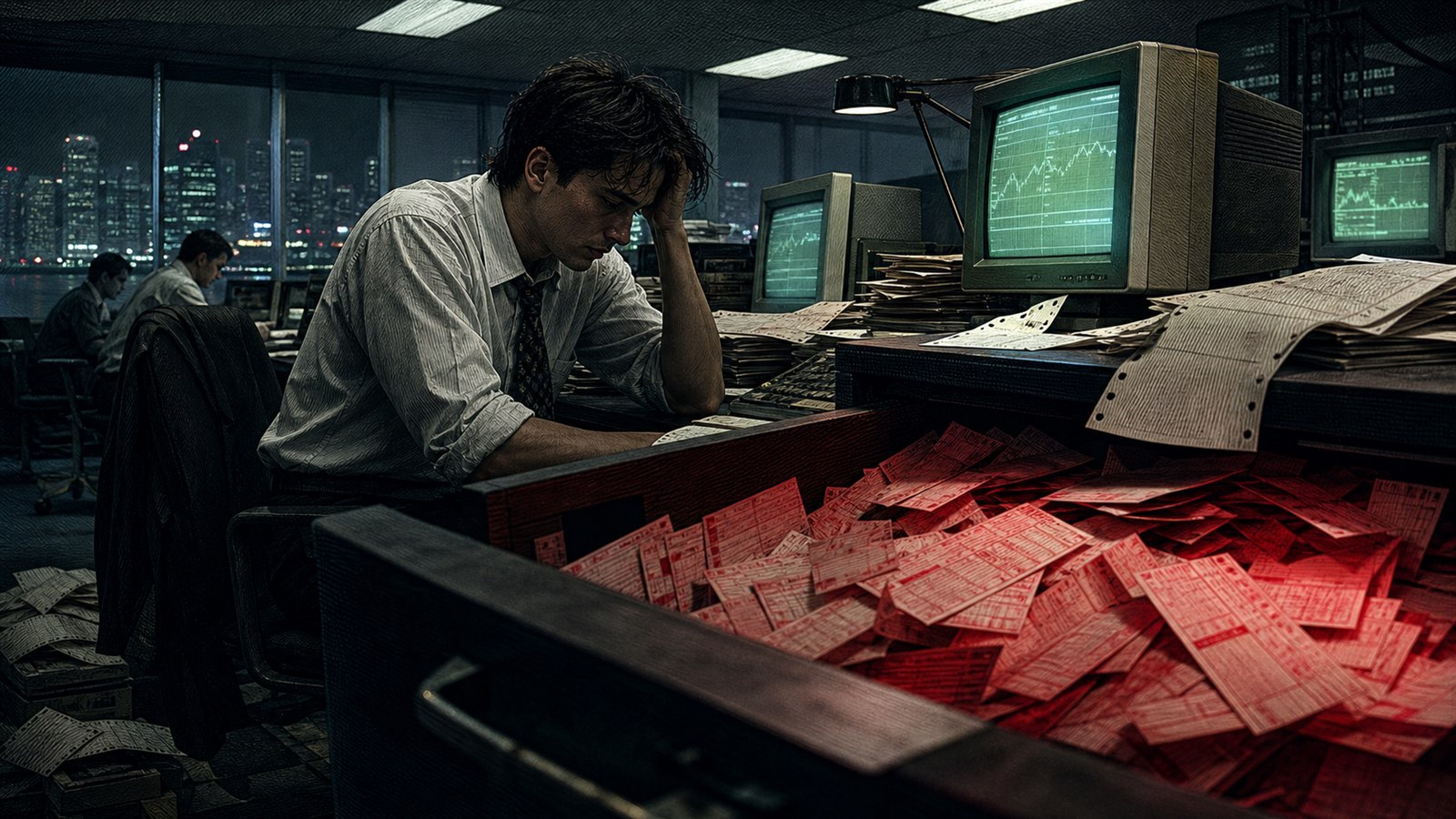
On February 23, 1995, Nick Leeson did not return to the office. In Singapore, his team waited. In London, Barings Bank began opening the drawers it had allowed him to keep closed for almost three years.
The first number was already bad. The next was worse. The positions surfacing in the systems resembled neither a typing error nor a single bad day. They were enormous, still open and still losing money while executives struggled simply to understand what the bank owned.
Leeson was supposed to exploit tiny price differences between the Singaporean and Japanese markets. It was almost mechanical: buy on one exchange, sell on the other, collect a small difference without betting on the market’s overall direction.
For months, he had reported profits. Barings celebrated him as one of its finest traders. It also sent ever larger sums to meet margin calls from the Singapore exchange.
That Thursday, the bank discovered that the profits lived in the reports. The losses were in account 88888.
Barings Had Financed Wars, Governments and Empires
Founded in 1762, Barings was one of Britain’s oldest merchant banks. It helped finance the United States’ Louisiana Purchase, lent to governments and survived crises that some countries did not.
Its name inspired a particular kind of confidence. It belonged to an older financial world where relationships, reputation and hierarchy mattered as much as figures. Yet when the bank expanded its Asian futures business in 1992, Nick Leeson was no heir to that world.
He came from the administrative side of trading. He understood confirmations, settlements and the accounts recording what traders had bought and sold. After a posting in Jakarta, he was sent to Singapore to establish Barings Futures Singapore.
He became both head of trading operations and head of the back office responsible for checking them. In other words, he took the risks and supervised the team meant to verify those same risks.
The anomaly was noticed. An internal audit in 1994 clearly warned of the failure to separate the roles. Its recommendations were not implemented. Leeson remained seated on both sides of the barrier.
Five Digits Gave Every Loss a Windowless Room
Account 88888 was presented as an error account. Mistakes occur in a trading room: a mistyped number, a contract assigned to the wrong place, a transaction that must be corrected before the close.
Leeson began putting into it the losses he did not want to reveal. Instead of reporting them, he took new positions in the hope of winning the money back. If the market moved his way, the hole would close and no one would ever need to know.
The market did not move far enough. The account grew.
To hide what was accumulating from London, a programmer altered the information sent by the accounting system. The number 88888 disappeared from certain reports. The false profits remained visible—clean enough to feed their author’s bonuses and reputation.
By the end of 1993, cumulative losses already exceeded £20 million. By the end of 1994, they were above £200 million. Yet in London, Leeson was still regarded as a source of extraordinary profit.
The account was not merely an accounting lie. It became a strategy: every time reality threatened to appear, Leeson increased the bet required to erase it.
London Sent the Money That Should Have Exposed the Lie
A futures position requires collateral. When it moves the wrong way, the clearing house demands more money. That mechanism exists precisely to prevent a loss from remaining abstract.
In Singapore, the margin calls exploded. Barings transferred the funds. A subsequent UK parliamentary report found that the bank had sent more than £300 million while the collateral attributed to the relevant clients amounted to only about £31 million.
The discrepancy should have triggered an immediate investigation. The demands for cash did not fit the reported activity. Yet managers assumed they came from client positions or temporary timing differences. They accepted Leeson’s explanations because his results made those explanations attractive.
The paradox became nearly perfect: to hide his losses, he needed money; to send him that money, the bank persuaded itself that he was winning.
Confirmations, margin calls and references to the account existed in several parts of the system. Account 88888 was not completely invisible. The clues that could expose it were simply never assembled by someone who possessed both the authority and the necessary suspicion.
The Kobe Earthquake Turned the Hole into an Abyss
On January 17, 1995, a powerful earthquake struck Kobe, Japan. The Nikkei fell. Leeson was heavily exposed to a rising Japanese market and suffered fresh losses.
Two choices remained. Admit that he had lied for years, or make an even larger bet on a rapid recovery. He increased his positions.
Contracts piled up on the Nikkei and Japanese interest rates. This was no longer an attempt to correct an account. Leeson was trying to force an entire market to return what he had lost. Every adverse move demanded more collateral and increased the sum Barings would have to cover.
The hoped-for rebound did not arrive as he needed it to. On February 23, he left Singapore. Investigators later found an apologetic note. The bank was left with the positions.
He was arrested in Frankfurt in early March and extradited to Singapore. Leeson’s personal story continued, but the story of Barings was already over.
By Sunday, the Bank Knew It Could Not Open on Monday
On February 26, 1995, Barings was declared insolvent. By the following day, the losses on Leeson’s positions had reached £827 million—more than the bank’s entire capital.
Authorities searched for a buyer able to absorb the liabilities and prevent a disorderly liquidation. The Dutch group ING eventually bought Barings for the symbolic price of one pound, taking on its debts and operations.
Nick Leeson pleaded guilty in Singapore and was sentenced to six and a half years in prison. His face became that of the “rogue trader,” the lone operator who brings down an institution through nerve and deception.
That description suited many people. It concentrated the whole affair on the man who falsified the accounts and allowed everyone to forget those who saw implausible profits, vast transfers and a manifestly dangerous organisation without forcing it to stop.
Leeson created and sustained the fraud. Barings gave him something rarer than money: the power to produce the official version of his own actions.
The Bank Did Not Lack Data. It Lacked Contradiction
After the collapse, reports stressed the separation of front and back offices, independent position controls and reconciliation of margin calls. The rules sound technical. They rest on a deeply human idea: no one should be allowed to mark their own work.
At Barings, the warning signs existed. They arrived in different forms, in different offices, before managers who each saw only one part of the problem. Opposite them stood a profitable, self-assured trader far from London, offering a coherent story.
The story held for as long as the market gave it time. When it broke, one weekend was enough to erase 233 years of banking.
Account 88888 was not placed where nobody could see it. It was placed exactly where nobody wanted to look for too long.


Discussion
Have something to add?
A detail, a disagreement or a lead worth pursuing? Tell us. Comments are reviewed before publication.