
The Phantom Army That Kept Hitler Away from Normandy
Double agents, radio traffic and a fictional army kept alive the idea that the real invasion was still coming somewhere else.
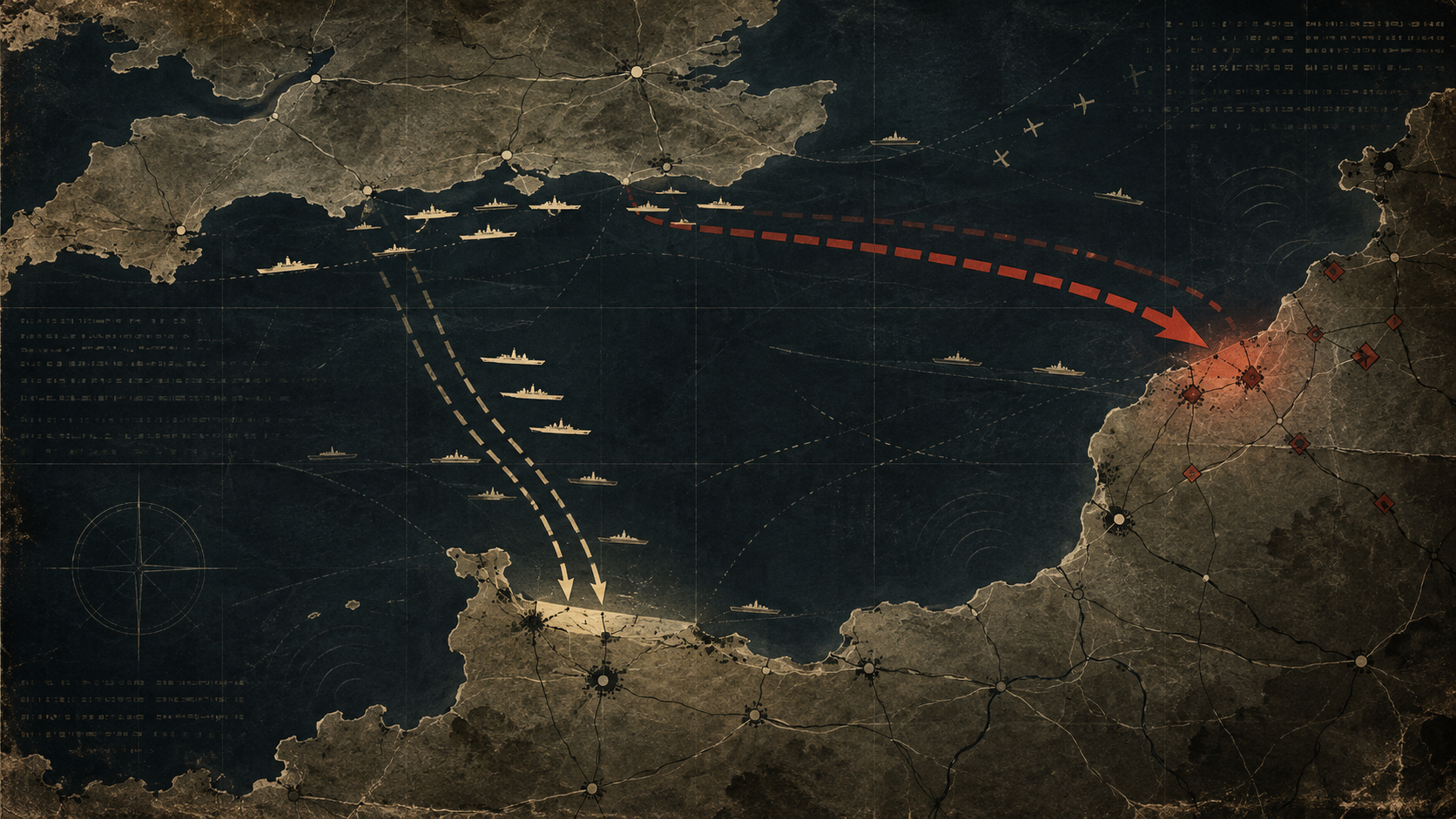
On 6 June 1944, the Allies landed in Normandy. Yet part of the German command still believed the main blow was due somewhere else. That mistake was not born on a beach. It had been built over months, around an army that did not exist.
One message sent by the double agent GARBO suggested to German authorities that Normandy might be a diversion. The real strike, according to that story, was still meant to come farther east, in the Pas-de-Calais.
The message did not arrive in a vacuum. The Pas-de-Calais is the narrowest stretch between England and France. To the German high command, it had long looked like the logical place for an invasion. The Allies did not need to invent that instinct. They needed to feed it, deepen it, and make it believable enough to survive the real landings.
That was the purpose of Operation Fortitude.
Making belief do the work
A convincing military deception does not necessarily begin with an outrageous lie. It begins with what an opponent is already prepared to believe.
In the spring of 1944, the Allies were preparing the war’s largest amphibious operation. Hundreds of thousands of men, ships, aircraft and pieces of equipment had to cross the Channel. The challenge was not simply to conceal the exact landing place. It was also to stop the German army from concentrating its reserves too early where they could crush the invasion.
The Pas-de-Calais offered a ready-made story: close, practical, obvious. Allied planners built a fictional force around that obviousness: the First U.S. Army Group, or FUSAG. On paper, it looked like a huge American army preparing to strike. In the story passed to the enemy, it was associated with George Patton, a famous general feared enough to give the illusion weight.
But an army is not just a name on a map. It needs movement, communications, visible signs, routines. It needs enough detail for its story to survive the curiosity of anyone trying to check it.
An army had to look as if it were at work
That was the trap: a fictional force that stayed too quiet did not exist, but one that displayed itself too carefully would look suspicious as well. Fortitude therefore had to manufacture not a still image, but a plausible military life. Units appeared to be sending messages, equipment appeared to be waiting, and a chain of command appeared to be preparing an operation that would never come.
That work was less photogenic than decoy equipment, but more demanding. Aerial reconnaissance, human intelligence and radio listening did not look at the same thing. The clues had to reinforce one another without repeating the same script. That is why dummy equipment, wireless traffic and double agents mattered only together: they offered several paths to the same wrong conclusion.
The enemy was not handed a story and ordered to believe it. It reconstructed an army for itself from the traces the Allies had chosen to leave behind.
Clues built to agree with one another
Fortitude was not merely a row of inflatable tanks placed in a field. Physical decoys did exist: dummy equipment, installations designed to be seen, staged activity. But they were only one part of the set.
The operation also depended on radio traffic and people. Wireless networks created the activity of units that were not there. Double agents controlled by the British through the Double Cross system sent selected intelligence back to Germany. The information could not look too perfect. It had to fit what Berlin already thought it understood.
GARBO was one of those agents. To his German contacts, he worked for them. In reality, he carried messages the Allies wanted them to receive. British archives preserve, among other material, a translation in which he described the Normandy landings as a feint meant to draw attention away from a main assault in the Pas-de-Calais.
The achievement was not simply sending that message. It was placing it inside a coherent world: an army said to exist, a general said to be preparing it, a plausible departure area, strategic logic reassuring enough for its audience to accept.
The lie had to outlive the real landings
On 6 June, the soldiers arriving on the Normandy beaches were obviously not fictional. Operation Overlord was real, costly, chaotic and deadly. That is what made Fortitude so difficult: once the battle began, the deception risked collapsing under the weight of the facts.
The Allies now had to preserve the idea that Normandy was only the first movement — not a complete invention, but one part of a larger campaign whose decisive blow still lay elsewhere.
That strategy helped keep German resources away from the place where they could have mattered sooner. The UK National Archives are careful in their wording: the operation helped convince the Germans that the main landings would take place on another section of the coast, contributing to the success of Normandy by diverting resources from the real invasion force.
The word “contributing” matters. Normandy did not hold because of fake tanks. It held through Allied preparation, naval and air power, fighting, German decisions, time gained, and the ability of troops to establish a bridgehead. Fortitude was not a magic wand. It was weight placed in the wrong part of the enemy’s balance.
The army that needed nobody
What remains extraordinary is not that an army could be imitated. It is that an imaginary army could keep producing real effects while the actual battle was already taking place in plain sight.
It did not need to cross the Channel. It did not need to fire. It only had to remain believable long enough in the enemy’s mind for men, trains and divisions to wait for a landing that would never come.
Leave a Reply