
They Didn’t Need to Prove Cigarettes Were Safe. They Only Had to Manufacture Doubt.
In December 1953, tobacco executives met in a grand New York hotel. They were not looking for a scientific answer. They were looking for a strategy.
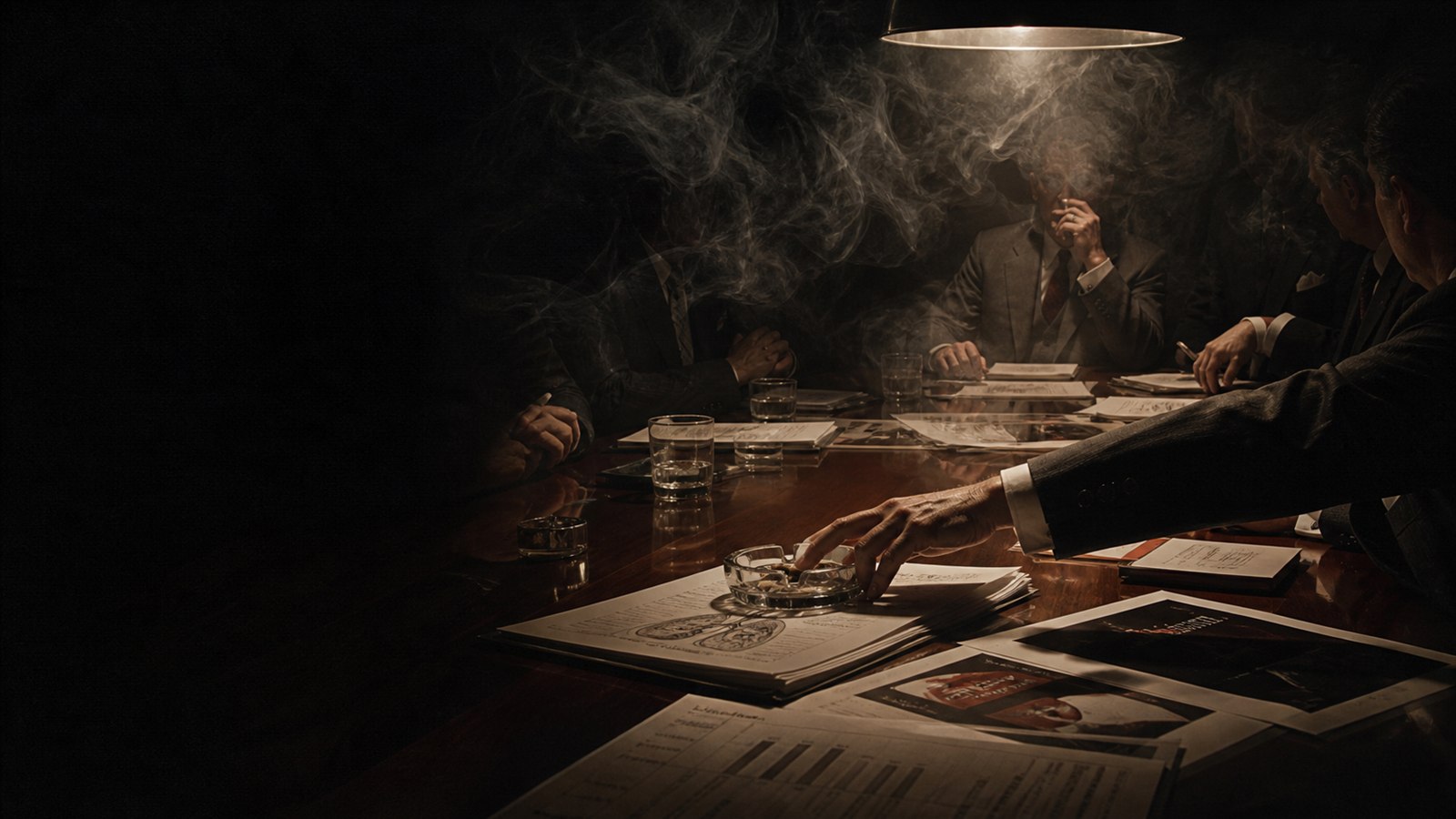
On December 15, 1953, the presidents of several of America’s largest tobacco companies met at New York’s Plaza Hotel. They ran rival businesses. That night, however, they all had the same problem.
For years, studies linking cigarettes to lung cancer had been accumulating. The press was paying attention. Sales were trembling, and smokers had begun asking a question capable of destroying an entire industry: does this product kill?
The executives had brought no cure. They had called John Hill, founder of one of the country’s most powerful public-relations firms.
Hill understood that flatly denying every study was dangerous. The next piece of evidence could expose the lie. He proposed a stronger defence: acknowledge that a question existed, emphasise everything that was not yet established with absolute certainty and keep demanding more research.
They did not need to win the scientific argument. They needed to stop the public believing it was over.
On January 4, 1954, the industry spoke with one voice
A few weeks after the meeting, a full-page advertisement appeared in 448 American newspapers. Its headline promised a frank statement to cigarette smokers.
The text claimed that public health came before every other consideration. It said manufacturers did not believe their products harmed health and stressed that cancer had many complex causes.
Most importantly, the companies announced a research committee that would fund independent scientists. It was a skilful move. At first glance, the industry was not running from evidence; it was asking for more.
At the same time, the statement created an almost unreachable standard. As long as any uncertainty remained over a mechanism, dose, individual or disease, the general link between smoking and harm could be presented as an open question.
Science advances by weighing probabilities and correcting its conclusions. Crisis communications turned that normal caution into a sales argument.
Doubt was no longer what came before knowledge. It became a way of delaying knowledge’s consequences.
While the public waited, the internal laboratories moved forward
Documents released decades later reveal a widening gap between what the companies said outside and what they discussed within.
Researchers employed or funded by cigarette manufacturers studied smoke components, carcinogenicity, nicotine absorption and dependence. Executives received memoranda far more direct than anything sent to consumers.
By the early 1960s, several companies possessed strong internal evidence that nicotine was addictive. That was not merely a health risk. It explained why the customer kept buying.
Outside, the language kept sliding carefully. Smoking was a habit, a pleasure, an adult choice. More proof was needed. Studies of other possible causes of disease were funded, then cited as evidence that the issue remained complicated.
The research committee did not necessarily manufacture false results. The mechanism was subtler: choose the questions, foreground uncertainty, give a minority of voices the same weight as an emerging consensus, and prolong a controversy long after it had ceased to be balanced.
In 1969, an internal memorandum gave the strategy a brutal name
At Brown & Williamson, a planning document put the idea into four words that became famous: “Doubt is our product.”
The sentence did not describe honest hesitation. It explained that doubt was the best way to compete with the body of fact already lodged in the public mind.
Advertising did not necessarily say, “Cigarettes are good for you.” It showed doctors, athletes, clean landscapes or a free individual. It stressed taste, smoothness and filtration. When risk became impossible to deny, the debate moved to its exact scale or to the smoker’s personal responsibility.
So-called “light” cigarettes captured that shift perfectly. Machines could measure lower tar, but smokers often compensated by drawing harder, smoking more often or covering the tiny ventilation holes in the filter. The word reassured even when actual exposure did not fall as consumers imagined.
The strategy no longer tried to persuade people that nothing was dangerous. It offered just enough uncertainty to let them postpone quitting.
A health warning must be clear enough to change behaviour. An industry needs only to introduce a reason to wait: a contradictory paper, a lone expert, a technical term, an alternative cause. If the public believes scientists are evenly divided, doing nothing can feel reasonable.
In 1994, seven executives raised their hands before Congress
On April 14, 1994, the heads of seven major tobacco companies appeared before a subcommittee of the House of Representatives. The image became historic: seven suited men standing in a row, taking an oath.
Questioned one after another, they said they did not consider nicotine addictive. The scene took place thirty years after the first internal research on dependence.
Yet the communications machine was beginning to crack. Whistleblowers spoke. Prosecutors and lawyers demanded company records. Millions of pages of memoranda, reports, emails and marketing plans slowly left the filing cabinets.
They revealed not one campaign decided in a single evening, but a continuity: monitoring unwelcome research, coordinating public responses, disputing second-hand smoke, promoting supposedly safer cigarettes and maintaining an interest in young consumers.
Each document on its own could appear debatable or incomplete. Together, they described an organisation that knew the time it gained had immense commercial value.
American justice finally called it an enterprise of deception
In 1999, the federal government sued major tobacco companies under RICO, a law designed to fight organisations engaged in coordinated fraud.
After a vast trial, Judge Gladys Kessler concluded in 2006 that the companies had deceived the public for decades about health risks, addiction, nicotine manipulation, second-hand smoke, youth marketing and “light” cigarettes.
Appeals continued for years. Manufacturers were eventually required to publish corrective statements. They appeared in newspapers, on websites and at points of sale — the exact opposite of the reassuring declaration from 1954.
Legal settlements had also forced the release of a huge body of internal documents. The University of California, San Francisco now preserves millions of them.
The archive exposes the machinery from inside: not only what the companies said, but what they knew when they said it.
Cigarettes lost their innocence. The method found other customers
The history of tobacco became a manual for manufacturing controversy. Researchers have shown similar tactics reappearing in debates over some chemicals, pollution and climate change: demand impossible certainty, magnify residual disagreement and present every regulation as premature.
That comparison does not mean every company disputing a study is repeating the tobacco conspiracy. It simply offers a useful question: is the research intended to understand a risk, or to delay the moment when someone must act?
In 1953, the executives at the Plaza had no evidence capable of clearing their product. They found something better for sales: a way to make every piece of evidence seem insufficient.
They sold cigarettes. Their most durable product was doubt.

Sources and verification
- UCSF Industry Documents Library — A Frank Statement to Cigarette Smokers, January 4, 1954
- US Department of Justice — summary of judicial findings in United States v. Philip Morris
- US Department of Justice — internal records and settlements related to their destruction
- UCSF — archive of internal tobacco-industry documents
- UCSF — analysis of the strategy targeting unwelcome research
Discussion
Have something to add?
A detail, a disagreement or a lead worth pursuing? Tell us. Comments are reviewed before publication.