
In the Scrap Yard, a Powder Glowed Beautiful Blue. No One Knew What It Was Doing to Their Bodies.
An abandoned radiotherapy machine was broken open in a Goiânia neighbourhood. The caesium passed from hand to hand before anyone understood why people were falling ill.
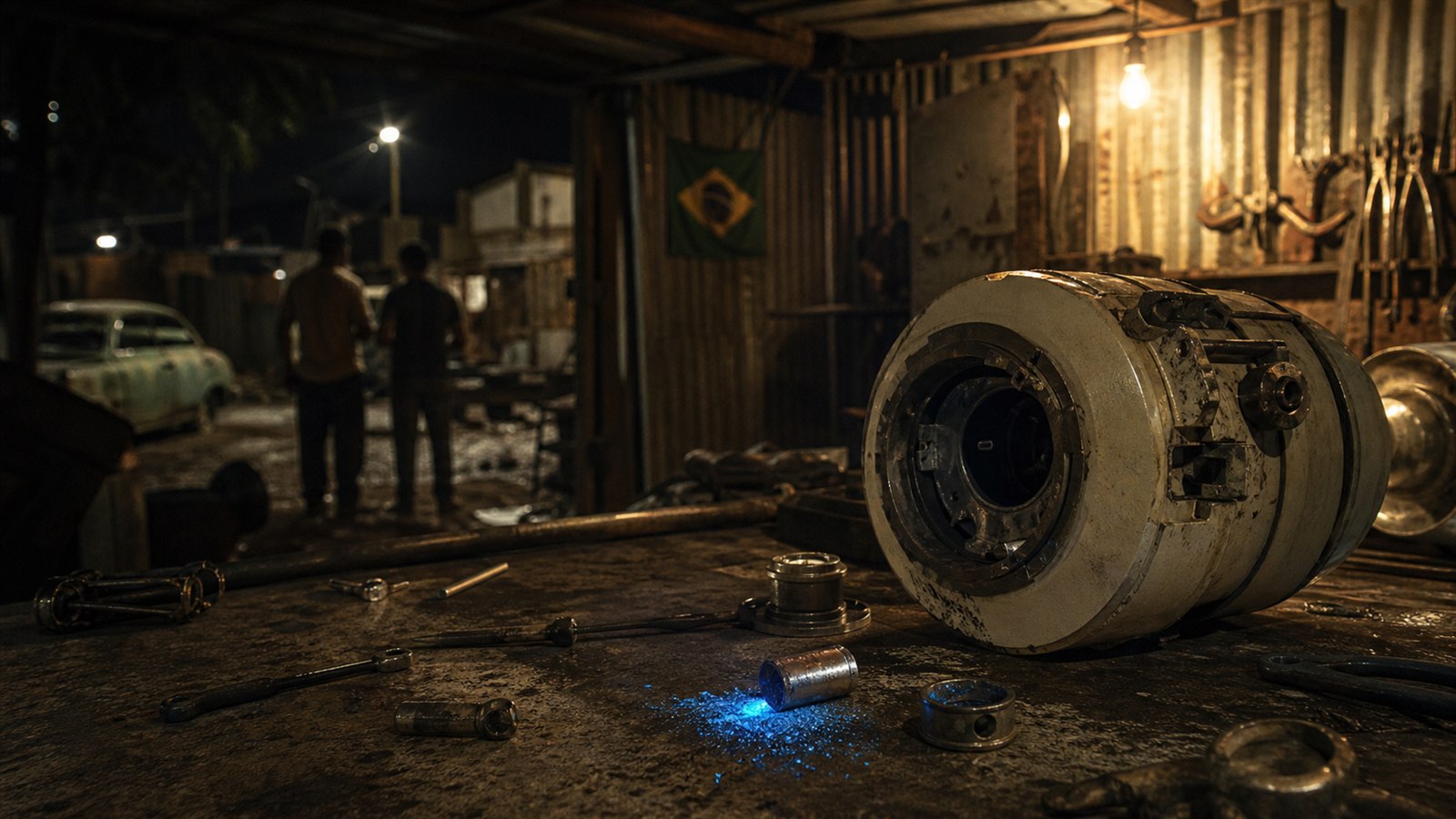
At night, Devair Alves Ferreira went back to look at the little capsule. In the darkness of his scrap yard, something inside was glowing. Not the dull yellow of heated metal or the reflection of a bulb, but a fine, almost unreal blue light.
Devair ran a scrap business in Goiânia, central Brazil. He knew copper, lead and the components that could be sold by weight. What he held in September 1987 resembled none of them. He scraped at the material, watched it sparkle and imagined something precious—perhaps even supernatural.
He showed the powder to his family. Fragments passed through hands, travelled into homes and touched skin. People wanted to see. They wanted to touch. Some carried pieces away to show the light to relatives.
Then the vomiting began. Crushing fatigue followed. Marks appeared on people’s bodies. They blamed spoiled food, an infection—anything that might explain why several people were becoming ill at once.
The answer was inside the capsule. It was invisible, odourless and still at work long after the blue light had vanished.
It Began in a Clinic That Should Never Have Been Left Open to the Curious
A few days earlier, two young men, Roberto dos Santos Alves and Wagner Mota, had entered the former premises of a radiotherapy institute. The clinic had moved, but a heavy machine remained. Its casing contained lead, a metal worth reselling.
Between September 10 and 13, they attacked the machine with ordinary tools. Eventually they removed a component weighing about 200 kilograms and pushed it to Roberto’s home on a cart.
The two men had no idea that the densest part was not merely shielded with lead. At its centre was the source once used to irradiate tumours: caesium-137 chloride sealed inside a capsule.
The source still had an activity of 50.9 terabecquerels. The number naturally meant nothing to them. What mattered was the metal housing. They struck it, punctured it and gradually separated the parts they could sell.
Both soon suffered nausea, diarrhoea and dizziness. They assumed they had eaten something bad. The component was sold to Devair’s scrap yard. From that moment, the accident no longer involved only two scavengers. It entered a neighbourhood.
The Blue Material Became a Curiosity to Be Shared
Caesium chloride has a disastrous property in this setting: it is a highly soluble powder. It clings to clothing, mixes with dust, enters wounds and can be swallowed or inhaled. A few grains were enough to carry contamination far beyond the capsule.
Devair was fascinated. The pieces moved through several scrap yards. Friends and relatives came to see the phenomenon. Some of the material was handled at a dinner table. Six-year-old Leide das Neves Ferreira ate a sandwich with contaminated hands.
No one tried to protect themselves because no one could see a danger. The light made the object look like the exact opposite: a discovery worth displaying with pride.
Radiation did not remain on the skin. Caesium behaves in the body rather like potassium and spreads through the tissues. People exposed externally could be washed and stripped of contaminated clothing. Those who had breathed or swallowed the powder carried it inside them.
Symptoms multiplied within the family. The lesions looked like burns, but no flame had made them. The doctors consulted still lacked the missing piece of the diagnosis.
Maria Gabriela Realised That the Sickness Followed the Object
Maria Gabriela Ferreira, Devair’s wife, noticed something more useful than any provisional diagnosis: the people who were ill had all been near the same object. On September 28, she decided to remove the capsule from the scrap yard.
The material was placed in a bag and carried by bus to a public health office. It looked like an ordinary scene: two passengers transporting something found among scrap. Yet throughout the journey, the source irradiated those around it and left contamination in its path.
At the health-surveillance office, the object was initially left where it was. The next day, a doctor finally suspected a radiological hazard. A physicist approached with a detector. The instrument saturated before he could even get close.
On September 29, sixteen days after the source had been opened, the accident finally acquired a name. The authorities alerted Brazil’s National Nuclear Energy Commission. They now had to trace every fragment, every house visited, every item of clothing worn and every person who might have touched the powder.
Maria Gabriela had not identified caesium. She had done something simpler and decisive: she refused to believe that all the illnesses were a coincidence.
More Than 100,000 People Filed Past the Detectors
News spread through Goiânia and fear changed scale. A screening centre was established in the city’s Olympic stadium. Queues formed. In all, 112,800 people were examined to determine whether they were carrying caesium.
Teams isolated seven major pockets of contamination. They tested houses, streets, food, soil, air and possessions. Families had to abandon their belongings. Buildings were emptied and demolished. Contaminated earth was removed.
Of everyone screened, 249 people showed significant internal or external contamination. Some were stripped of their clothes and washed. A total of 129 required medical monitoring; fifty had incorporated caesium into their bodies. Twenty were hospitalised in Goiânia and fourteen severe cases were transferred to Rio de Janeiro.
Four people died in the following weeks, among them Leide and Maria Gabriela. Twenty-eight developed radiation skin lesions. Others lived on with treatment, examinations and anxiety about what the contamination might still do.
The entire city had not been irradiated. Yet everyone was seized by a question only instruments could answer: who had crossed the dust’s path?
A Few Grams Ended Up Filling Thousands of Cubic Metres
Decontamination turned ordinary objects into radioactive waste: furniture, clothing, rubble, tools, soil and pieces of wall. The Goiás state government puts the final volume at 3,500 cubic metres, packed into concrete containers. Other assessments describe roughly 6,000 tonnes.
The waste is stored at Abadia de Goiás, about twenty kilometres from the state capital. The site must be monitored for decades. Caesium-137 loses half its activity in a little over thirty years; it did not disappear when the emergency operation ended.
Nor did the physical clean-up erase the fear. Residents of Goiânia encountered distrust elsewhere in Brazil. Produce from Goiás state was rejected. Direct victims faced not only medical consequences, but the way other people now looked at them.
In 1988, a foundation bearing Leide’s name was created to monitor the exposed population. A six-year-old child gave her name to an institution because adults had left a dangerous powder unguarded in the middle of a city.
The Danger Was Not Hidden by Science. It Was Abandoned by Those Who Understood It
The Goiânia accident did not arise from incomprehensible technology. The machine had an owner, a purpose and safety rules. Its capsule was shielded precisely because the risks were known.
That knowledge simply did not follow the machine into the abandoned building. When Roberto and Wagner found it, there was no guard, no warning capable of stopping them and no professional to explain what stood before them.
A source designed to heal had crossed into another world. Inside a clinic, it was identified, shielded and handled according to a protocol. In a scrap yard, it was merely heavy metal containing a beautiful light.
Sixteen days separated the first blow of a tool from the first detector reading. It then took the screening of 112,800 people to trace the path of a handful of blue powder.
Sources and fact-checking
- International Atomic Energy Agency — The Radiological Accident in Goiânia
- Goiás State Health Department — history of caesium-137 in Goiânia
- Goiás State Health Department — testimonies and chronology of those involved
- Brazilian National Nuclear Energy Commission — information on the accident and waste
Discussion
Have something to add?
A detail, a disagreement or a lead worth pursuing? Tell us. Comments are reviewed before publication.