
The Sheikh Was Fake. The Envelopes, Politicians and Hidden Cameras Were Not.
The FBI wanted to recover stolen paintings. Its fictional billionaire ended up meeting members of Congress prepared to sell their influence.
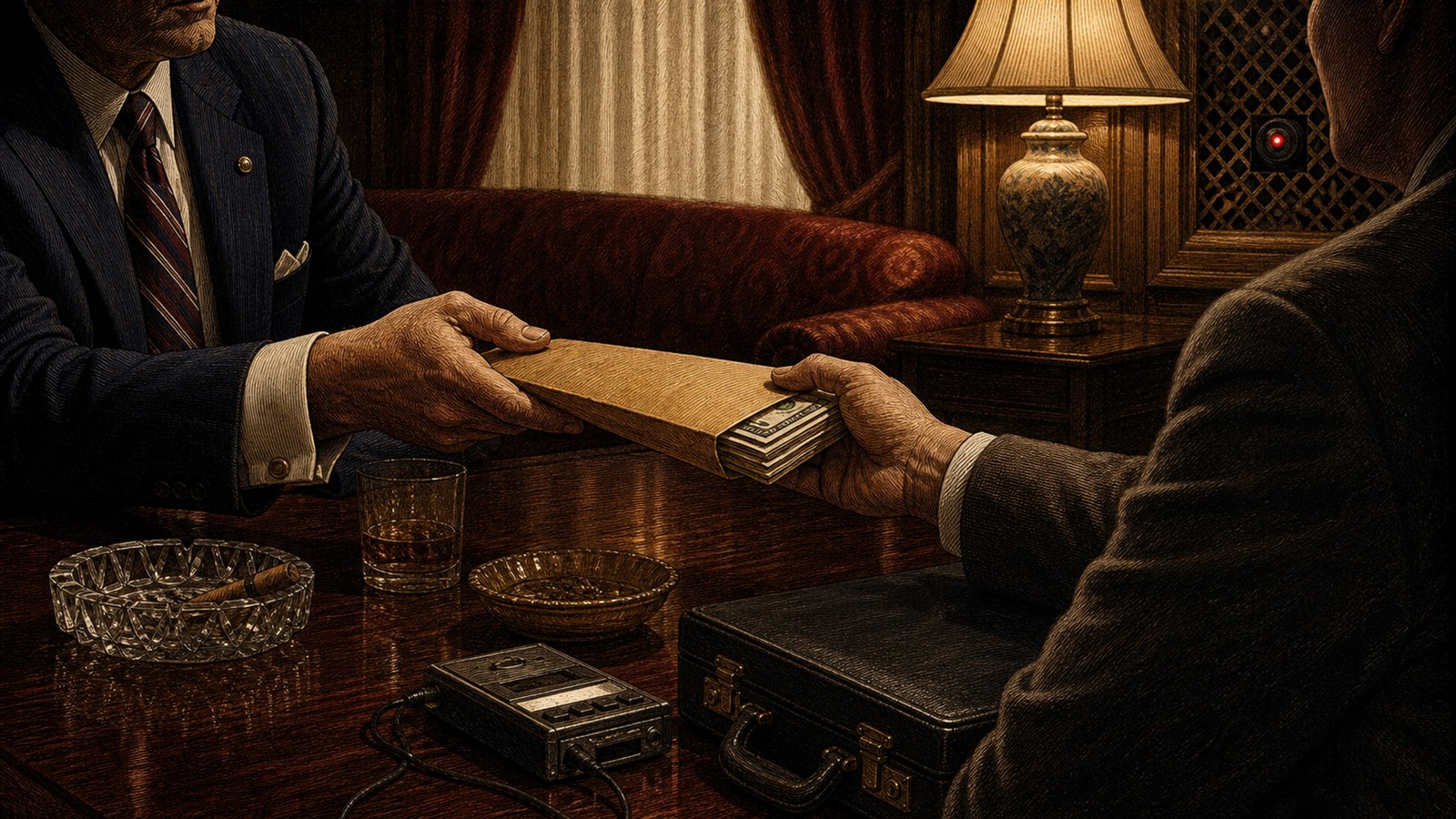
The camera was running when Michael Myers entered the room. The Pennsylvania congressman had not come to meet a constituent, still less to debate a bill. On the table, an FBI agent had prepared an envelope containing $50,000.
The money changed hands in front of several witnesses. Myers took it. The scene unfolded neither in a back room nor at the far end of a car park, but inside an operation where almost everything had been invented: the company, the intermediaries, the advertised fortune and the powerful foreign sheikh in whose name they bargained.
Only one thing was not simulated. The banknotes were real.
The FBI had promised that its mysterious investor could spend millions in the United States. In return, he wanted favours: an Atlantic City casino licence, political influence and, eventually, a way to remain in the country if a revolution drove him from home.
No member of Congress was supposed to appear in the story at first. The trap had been built for art thieves.
Abdul Enterprises Was an Empty Company Built to Buy Stolen Art
In July 1978, the FBI was trying to infiltrate the stolen-art trade in New York. Agents created a fictitious business on Long Island: Abdul Enterprises Limited. Its name later supplied the operation’s label, ABSCAM—a contraction of “Abdul” and “scam.”
The company supposedly represented a wealthy Arab sheikh eager to invest oil money in valuable paintings. To bring the cover to life, the FBI relied on Mel Weinberg, a convicted swindler who knew precisely the language, habits and vanities of the men he had to approach.
Weinberg did not look like an agent. That was his principal advantage. He knew how to sell a story while giving the person opposite him the pleasure of thinking he had understood it first.
The scheme worked. Within months, agents recovered two stolen paintings worth about $1 million in total. Weinberg’s contacts then offered them something else: fraudulent securities with a face value in the hundreds of millions.
The fictional sheikh seemed to possess an unlimited appetite. Sellers brought him ever larger deals. The operation eventually blocked the sale of nearly $600 million in fraudulent securities.
Then the intermediaries stopped talking only about criminals. They began talking about politicians.
In Atlantic City, the Sheikh’s Oil Money Needed a Casino Licence
Gambling had just been legalised in Atlantic City, New Jersey. Casino projects attracted developers, criminal networks and local officials capable of opening or closing an administrative door.
Representatives of Abdul Enterprises announced that their employer wanted to invest in a hotel complex. He had the money, but not the approvals. Political contacts offered to smooth the process in exchange for payments.
Angelo Errichetti, mayor of Camden and a New Jersey state senator, became a central intermediary. He introduced the undercover agents to officials who might help the project. As the fake investment gained credibility, the meetings climbed towards Washington.
The script acquired a new problem. The sheikh feared being overthrown in his own country and wanted asylum in the United States. A private bill passed by Congress could resolve his case. Members of Congress were therefore invited to meet his representatives.
The price was simple: $50,000 immediately, then another $50,000 after the favour had been delivered.
Every meeting confronted the participants with a clear choice. They could leave, refuse, alert the authorities or ask questions. Some did walk away without money. Others stayed long enough to negotiate.
The Rooms Were Decorated to Persuade, Then Wired to Remember
The agents could not rely on an informant’s word. They recorded the meetings. Cameras captured the gestures, envelopes, promises and moments when an elected official understood exactly what was being asked.
Undercover agent Anthony Amoroso played one of the sheikh’s representatives. Weinberg sustained the façade. Around them, every detail had to withstand the scrutiny of professionals accustomed to wealthy investors: offices, businessmen, documents and visible signs of money.
The technique was formidable because it did not ask every participant to commit a crime in the opening sentence. At first, they discussed projects, access and relationships. The language remained vague enough for each person to tell himself that this was still an ordinary conversation.
Then the money appeared.
On August 22, 1979, Michael Myers accepted his envelope. In video later made public, he appeared entirely at ease with the idea that money governed the scene. Other officials were filmed over the following months. Some took funds, some promised influence and some discussed the best way to push the sheikh’s request through.
The men thought they were meeting a foreign fortune that needed American politics. In reality, they were speaking to American law enforcement, which needed evidence.
On February 2, 1980, the Sheikh Collapsed into Newsprint
An operation of this size did not remain secret until the final trial. On February 2, 1980, the press revealed the investigation. The country discovered the name ABSCAM, the videos and the list of officials under scrutiny.
The images were shocking because they removed much of the usual comfort from a political scandal. This was not merely a matter of dubious donations, conflicting memories or accounts too tangled to follow. Viewers saw elected officials sitting in front of the cash.
By the end of the proceedings, one US senator, Harrison Williams, six members of the House of Representatives and more than a dozen other officials or intermediaries had been convicted. Michael Myers was expelled from the House in October 1980, then an exceptionally rare punishment.
Several careers ended. The recordings became central evidence at trial, but also political objects. They showed corruption with a clarity the convicted officials’ opponents could replay indefinitely.
The investigation’s success raised another question: how far can police manufacture an opportunity for corruption in order to prove that an official is corruptible?
The Defendants Said They Had Been Pushed. The Courts Looked at What They Chose
Defence lawyers attacked the operation as entrapment. In their view, the government had not merely observed a crime: it had invented the sheikh, the money and the immigration problem, then drawn elected officials into its script.
The criticism was not frivolous. A democracy must be wary of police who can manufacture temptations to order, particularly when political officials are the targets. The power to choose a target and build the stage can itself be abused.
The courts, however, examined the recorded conduct. They concluded that those convicted had not been coerced and had shown themselves willing to accept payment. The convictions stood.
The affair nevertheless led to tighter rules governing FBI undercover operations. From 1981, new attorney-general guidelines defined the supervision required for such investigations, particularly those involving public corruption.
ABSCAM thus became both model and warning: a model for recording covert transactions, and a warning about the power the state assumes when it writes the opening of the story itself.
The Fake Sheikh Had No Country. The Politicians Had Already Named Their Price
The strangest part is the investigation’s gradual migration. A company invented for stolen paintings attracted sellers of fraudulent securities, then casino intermediaries, then local officials, then members of Congress.
The FBI never uncovered one vast, unified conspiracy. It followed a chain of people who knew someone, who knew someone, who believed they could sell access. Each link presented the next as a natural extension of business.
The sheikh never had a credible name, a government or a people. He never faced exile and never wanted to build a casino. He was merely a reservoir of money large enough to make certain men stop asking questions.
The fake sheikh never existed. The price of democracy had nonetheless been set with remarkable precision.
Discussion
Have something to add?
A detail, a disagreement or a lead worth pursuing? Tell us. Comments are reviewed before publication.